
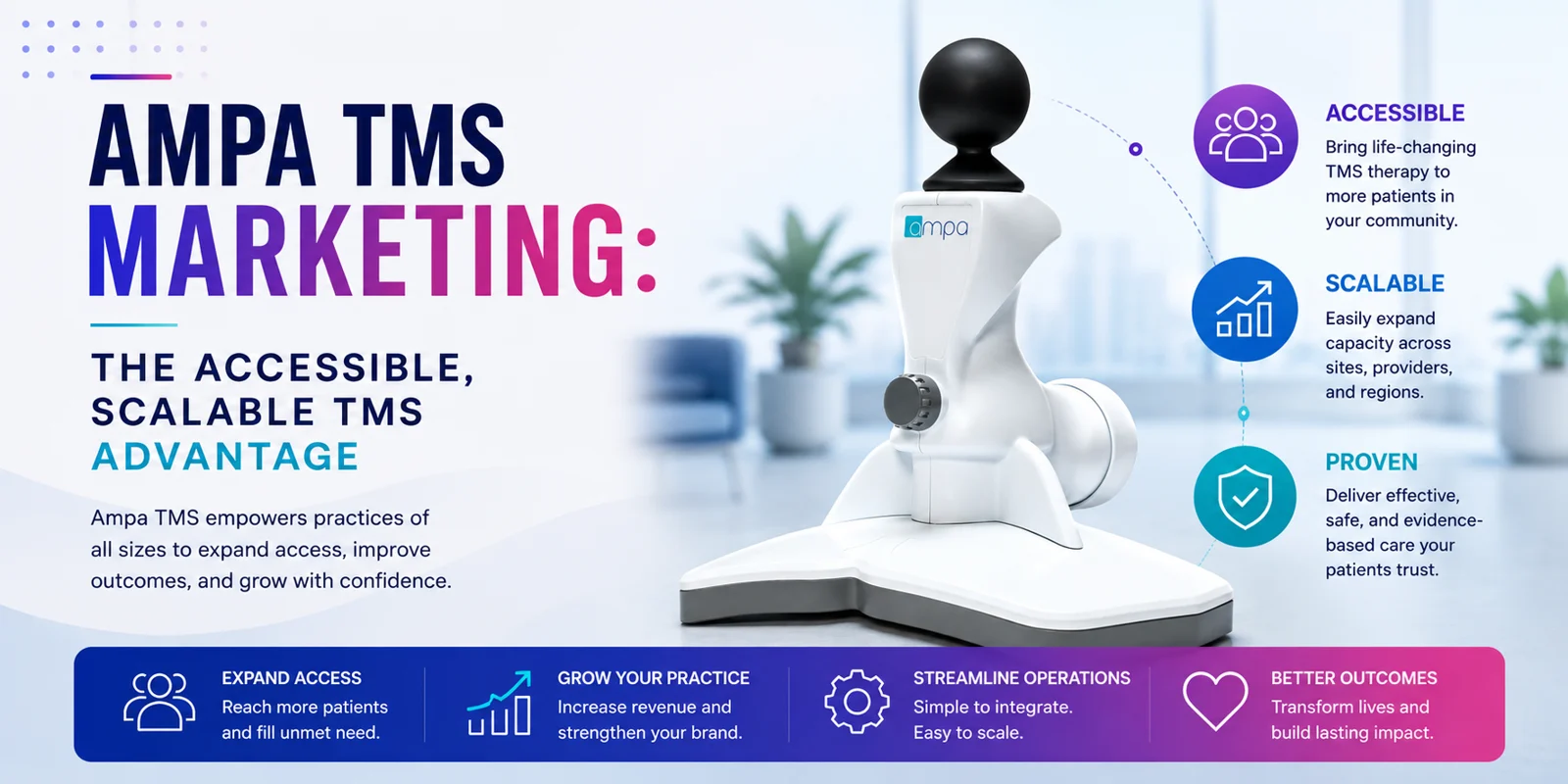
Neurovo is a leader in interventional psychiatry advertising and can help you with your Ampa TMS Marketing. Most TMS devices were built for a different era—an era when $150,000+ equipment purchases, weeks of technician training, and single-location practices were the only path to offering brain stimulation therapy. Ampa looked at that model and asked: what if TMS could work more like modern technology?
The Ampa One system represents something genuinely new in the TMS landscape. A device that fits in two rolling suitcases. A subscription model that eliminates six-figure capital outlays. Training measured in hours, not weeks. Camera-guided precision that ensures consistent targeting without complex calibration rituals.
And behind all of it: Dr. Jonathan Downar, senior author of the landmark THREE-D trial that proved 3-minute theta burst sessions work as well as 37-minute conventional protocols. The science that changed TMS treatment times came from Ampa’s co-founder.
This guide covers how to position Ampa One’s unique advantages—accessibility, scalability, and scientific credibility—to attract patients and grow your practice. For foundational TMS marketing principles, see our complete guide. Learn more by reading our TMS Therapy Marketing Complete Guide.
Ampa One’s Marketable Differentiators
Ampa One competes on dimensions that established TMS devices simply can’t match: portability, affordability, and operational simplicity.
Portable Power: TMS That Goes Where Patients Are
The entire Ampa One system fits in two checkable, wheeled suitcases. The treatment coil weighs 2.2 pounds—compared to 10+ pounds for conventional TMS coils that require heavy mounting systems.
This portability creates possibilities that stationary equipment can’t offer. Satellite clinics become feasible without duplicating expensive equipment. Practices can bring TMS to underserved locations. Multi-site operations can share equipment strategically. The technology goes where patients need it rather than requiring patients to come to where the technology lives.
For marketing, portability enables positioning around access: “TMS treatment closer to home” or “bringing advanced depression treatment to communities that need it.” This resonates particularly in markets underserved by traditional TMS providers.
Subscription Model: No Six-Figure Barrier
Traditional TMS equipment requires $100,000–$250,000 in upfront capital. Ampa One operates on an all-inclusive subscription at $3,000 per month—covering the system, coil replacements, installation, and operator training.
For practices, this transforms TMS economics. No massive capital outlay. No depreciation schedules. No coil replacement surprises. Predictable monthly costs that scale with the business. Month-to-month flexibility rather than long-term equipment commitments.
While this is primarily a practice-facing advantage, it indirectly benefits patients through expanded access. More practices can afford to offer TMS. More locations become viable. More patients find treatment within reach.
Operational Simplicity: Hours to Master, Not Weeks
Conventional TMS systems require approximately four weeks of technician training. Ampa One can be mastered in hours. The system is designed by clinicians for clinicians—intuitive operation rather than complex calibration procedures.
Session setup takes less than one minute. Camera-embedded coils guide positioning. Preprinted caps ensure consistent targeting. Video recordings enable quality control on every session. The system handles the technical complexity so operators can focus on patient care.
Camera-Guided Neuronavigation
Ampa One embeds cameras directly in the treatment coil, enabling real-time visual guidance for precise positioning. Combined with preprinted targeting caps, the system ensures accurate coil placement without requiring expensive external navigation hardware.
Every session is video recorded, creating a quality control archive that verifies treatment was delivered correctly. This documentation provides both clinical confidence and operational oversight—particularly valuable for multi-site or telemedicine-enabled operations.
Patient-facing messaging: “Precision targeting with every treatment” and “camera-guided accuracy.” The technology story is simple enough for patients to understand while still conveying sophistication.
High Throughput: More Patients, More Outcomes
Ampa One enables practices to deliver up to 15 full treatment courses per workweek—compared to 2–3 courses for conventional TMS systems. Faster session setup, no equipment cooling delays, streamlined workflows. The same quality treatment delivered to more patients.
For practices, this means treating 2–3 times more patients per room per day. For patient-facing marketing, throughput translates to availability: shorter wait times, more appointment flexibility, easier scheduling.
THREE-D Trial Founder: Scientific Credibility
Ampa’s co-founder, Dr. Jonathan Downar, is the senior author of the THREE-D trial published in The Lancet—the landmark study that proved 3-minute theta burst stimulation works as effectively as 37-minute conventional protocols. Dr. Downar has published over 180 peer-reviewed articles on brain imaging and TMS in journals including Lancet, Nature Medicine, JAMA Psychiatry, and the American Journal of Psychiatry. He’s an Adjunct Professor of Psychiatry at the University of Toronto with a quarter-century of TMS research experience.
For marketing, this is rare credibility: “developed by the scientist who revolutionized TMS treatment times.” The founder isn’t a business executive who hired researchers—he is the researcher whose work changed how TMS is delivered worldwide.
Positioning Against Established Competitors
Ampa One enters a market with established players who’ve spent years building brand recognition. Effective positioning emphasizes what Ampa offers that incumbents can’t easily replicate.
The Accessibility Angle
Position Ampa as expanding access to TMS—both for practices that couldn’t previously afford equipment and for patients in locations underserved by existing providers. “TMS for everyone who needs it” speaks to Ampa’s mission of helping one billion people reach remission.
This positioning works particularly well in markets without established TMS presence or in communities where cost barriers have limited treatment availability.
The Innovation Angle
Established TMS devices represent 2008–2018 thinking applied to brain stimulation. Ampa One represents what TMS looks like when designed with modern technology philosophy: subscription models, cloud connectivity, camera-guided precision, radical portability.
For patients who value innovation and modern approaches, positioning Ampa as “next-generation TMS” captures interest.
The Scientific Founder Angle
Most medical device companies are founded by engineers or business executives. Ampa was co-founded by a psychiatrist-researcher whose work fundamentally changed TMS protocols. This isn’t a technology company selling to clinicians—it’s a company built by clinicians to solve clinical problems.
“Built by clinicians, for clinicians” resonates with both patients (who trust clinical expertise) and referring physicians (who respect research credentials).
Target Audiences for Ampa Marketing
Treatment-Resistant Depression Patients
Ampa One is FDA-cleared for treatment-resistant depression—the core TMS market. Standard TMS marketing principles apply: acknowledge the patient’s journey through failed medications, position TMS as a different approach, emphasize non-drug treatment.
Ampa-specific advantages for this audience include potentially shorter wait times (higher throughput means more availability) and locations they might not otherwise have access to.
Patients in Underserved Markets
Ampa’s portability enables TMS in locations where traditional equipment economics didn’t work: smaller cities, rural areas, communities without existing TMS providers. For patients in these areas, Ampa may represent their first realistic access to TMS treatment.
Marketing in underserved markets should emphasize availability itself: “TMS treatment now available in [location]” becomes newsworthy when no local option previously existed.
Innovation-Oriented Patients
Some patients actively seek the most advanced, innovative treatment options. They research extensively, compare technologies, and appreciate modern approaches. Ampa’s camera-guided navigation, cloud connectivity, and next-generation design appeal to this audience.
Content for this audience should include technical details about the system’s innovations—these patients want to understand what makes Ampa different, not just that it is different.
Patients Who Previously Couldn’t Access TMS
Whether due to location, scheduling constraints, or practice capacity limits, some patients have been unable to access TMS despite wanting treatment. Ampa’s high throughput and potential for expanded locations may remove barriers these patients previously faced.
Content Strategy for Ampa Practices
Blog Topics
Build content around accessibility, innovation, and scientific credibility:
- “Next-Generation TMS: How Ampa One Is Different” — positions innovation advantage
- “TMS Now Available in [Location]” — announces new service areas enabled by portability
- “The Science Behind Ampa: From THREE-D Trial to Clinical Practice” — leverages founder credibility
- “Camera-Guided TMS: Precision Targeting Explained” — technical content for research-oriented patients
- “What Makes Portable TMS Possible?” — education piece that differentiates from bulky traditional systems
Video Content
Ampa’s portability creates unique video opportunities. Show the system being set up in minutes. Demonstrate the compact form factor. Let viewers see how different this looks from the imposing equipment they might associate with TMS.
Ampa’s own website features powerful patient testimonials describing transformative outcomes. With proper consent, similar stories from your practice build local credibility.
SEO Strategy for Ampa Practices
Target Keywords
Brand keywords: “Ampa TMS near me,” “Ampa One TMS [city],” “Ampa Health providers”
Innovation keywords: “portable TMS treatment,” “next-generation TMS,” “modern TMS therapy,” “camera-guided TMS”
Accessibility keywords: “TMS therapy [underserved location],” “new TMS provider [city],” “affordable TMS treatment”
Local SEO
For practices in areas previously without TMS, local SEO can capture searches from patients who may not have searched before—because they assumed no local option existed. Optimize for local depression treatment terms, then let TMS availability differentiate your practice.
Google Business Profile should mention Ampa One and any specific accessibility advantages your practice offers—additional locations, extended hours, shorter wait times.
Paid Advertising for Ampa Practices
Ampa brand keywords currently have minimal competition—the company is newer and less widely known than established TMS brands. This creates an opportunity for early-mover practices to establish search presence at relatively low cost.
Ad copy should emphasize accessibility and innovation: “Next-generation TMS treatment” and “advanced portable TMS” position the technology appropriately.
For practices in underserved areas, geographic targeting around “TMS + [location]” may be particularly effective—you may be the only provider appearing for those searches.
Physician Referral Marketing
Psychiatrists
Psychiatrists familiar with TMS literature likely know the THREE-D trial. Leading with that connection—”the system developed by Dr. Downar, senior author of the THREE-D study”—provides immediate credibility. That trial was published in The Lancet; that journal carries weight.
For psychiatrists who haven’t previously referred to TMS due to lack of local providers, Ampa’s portability may have enabled a new option in their referral network.
Primary Care Physicians
Keep the message simple. PCPs need to know TMS is available, it works, insurance covers it, and you’ll communicate about their patients. If you’re a new TMS provider in an area previously without one, introduce yourself as expanding access: “Your patients now have local TMS options for treatment-resistant depression.”
Ampa TMS Marketing. Marketing the TMS Revolution
Ampa One represents a genuine departure from traditional TMS—not just incremental improvement, but rethinking how brain stimulation technology should work in the modern world. Portable, affordable, subscription-based, and simple to operate.
The practices that succeed with Ampa marketing will be those that embrace this positioning: accessibility, innovation, and the scientific credibility that comes from having a THREE-D trial founder at the company’s core. You’re not offering a slightly different TMS device. You’re offering a different model for how TMS can reach patients who need it.
For patients, the message is simple: effective TMS treatment is now available in ways it wasn’t before—closer to home, with more availability, guided by precision technology. That’s a story worth telling.