
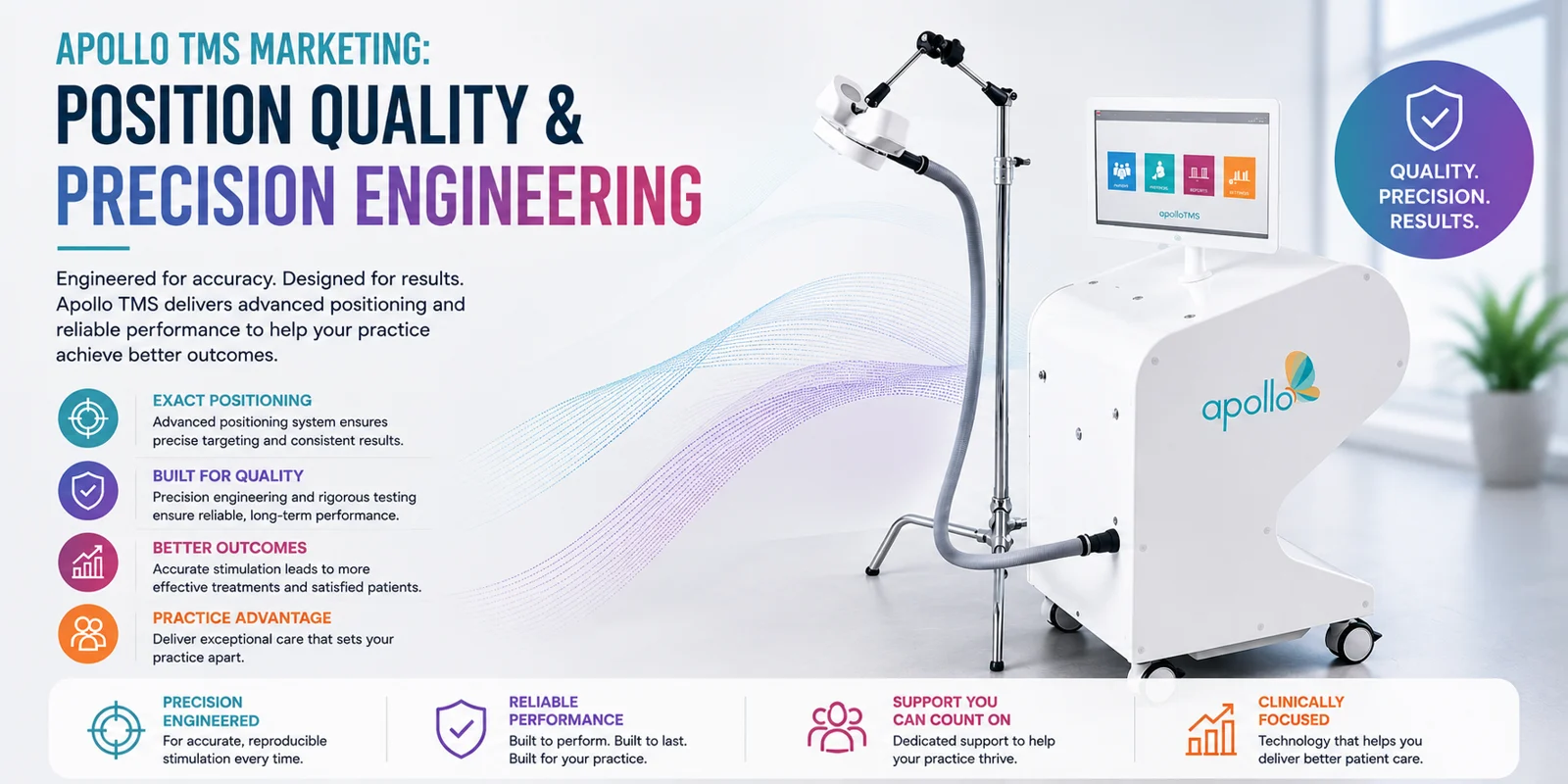
We offer expert Apollo TMS Marketing solutions to help grow your practice. Apollo TMS operates in an interesting market position. Manufactured by MAG & More in Germany and distributed in the U.S. by neurocare group, it’s a newer entrant to the American market that’s rapidly expanding—with over 300 installations and growing.
The Apollo system doesn’t claim to be first or biggest. What it offers instead is engineering precision, an expanding indication portfolio, and integration with neurocare’s broader mental health treatment philosophy. For practices that chose Apollo, these qualities matter—and they can become marketing differentiators.
This guide covers how to position Apollo TMS effectively against more established competitors by emphasizing what makes your device and practice distinctive. For foundational TMS marketing principles, see our complete guide. TMS Therapy Marketing Complete Guide.
Apollo’s Marketable Differentiators
Apollo TMS may lack the market history of NeuroStar or the unique indications of BrainsWay, but it has genuine differentiators worth emphasizing.
German Engineering Excellence
MAG & More, Apollo’s manufacturer, is based in Munich and brings German engineering standards to TMS technology. “German engineering” carries meaningful connotations: precision, quality, attention to detail, rigorous standards.
This isn’t empty branding. Germany has some of the world’s strictest medical device regulations, and products manufactured there reflect those standards. For patients comparing options, “German-engineered precision” provides a quality signal that differentiates from the crowded field of FDA-cleared devices.
The positioning works particularly well with patients who research thoroughly and care about quality indicators. It also resonates with physicians who appreciate engineering rigor in medical devices.
HANS Positioning System
Apollo’s Head-And-Neck-Support (HANS) system provides consistent, comfortable positioning throughout treatment. Consistent positioning means consistent treatment delivery—the coil stays where it should be, session after session.
In marketing, this becomes messaging around precision and comfort: “Precision positioning ensures every treatment targets exactly the right location.” For referring physicians evaluating TMS options, technical precision differentiates.
Expanding Indications
Apollo has been actively expanding its FDA-cleared indications. Recent clearances include OCD (August 2025), adolescent depression (September 2025), and iTBS protocols (August 2024). This progression signals an active, growing platform rather than a static technology.
For marketing, it demonstrates that Apollo is investing in research and regulatory approval—a company focused on the future, not resting on past clearances.
The neurocare Integrated Model
neurocare group doesn’t just sell TMS devices—they operate an integrated mental health treatment model that combines multiple modalities. Association with neurocare’s treatment philosophy can support positioning around comprehensive, thoughtful care.
Positioning Against Established Competitors
Apollo competes against devices with larger market share and longer track records. Effective positioning acknowledges the market reality while emphasizing genuine advantages.
Quality Over History
NeuroStar has been around since 2008. Apollo hasn’t. Trying to compete on track record is a losing game. Instead, position quality: “The latest in TMS technology” or “German-engineered precision” shifts the conversation from history to capability.
Some patients actually prefer newer technology—they want the latest advancement, not the oldest option. For this segment, Apollo’s relative newness becomes a feature rather than a limitation.
Growing Network Credibility
Over 300 U.S. installations isn’t the largest network, but it’s substantial. “Trusted by over 300 practices nationwide” provides credibility without claiming to be the biggest.
The Modern Choice
Position Apollo as the choice for practices that prioritize quality engineering and modern technology. This attracts patients who do their research, compare options, and make thoughtful decisions—often excellent patients who complete treatment and refer others.
Target Audiences for Apollo TMS Marketing
Treatment-Resistant Depression Adults
The core TMS market. For Apollo practices, emphasize precision, quality, and the expanding protocol options including iTBS for shorter sessions. The German engineering angle provides differentiation for patients comparing their options.
Adolescent Depression (Where Cleared)
With Apollo’s September 2025 adolescent clearance, practices can now market to parents of depressed teenagers. Positioning around age-appropriate treatment and the precision of HANS positioning resonates with concerned parents.
OCD Patients (Where Cleared)
Apollo’s August 2025 OCD clearance opens this patient population. Apollo practices in areas without BrainsWay providers can capture OCD patients seeking TMS treatment.
Quality-Conscious Patients
Some patients research extensively and make decisions based on perceived quality rather than just availability or convenience. German engineering, precision positioning, and association with a thoughtful treatment philosophy appeal to this segment.
Content Strategy for Apollo Practices
Blog Topics
Build content that positions Apollo’s unique advantages:
- “Why TMS Precision Matters for Your Treatment” — positions HANS and engineering quality
- “Apollo TMS: German Engineering Meets American Healthcare” — differentiates through origin story
- “What to Expect with Apollo TMS Treatment” — standard patient education with device-specific details
- “TMS Options for [Condition]: Understanding Your Choices” — condition-specific content for each cleared indication
Leveraging neurocare Resources
neurocare group provides marketing support for Apollo practices. This may include practice locator listings, patient education materials, and clinical resources. Contact your neurocare representative to understand what’s available—manufacturer marketing support often goes underutilized.
SEO Strategy for Apollo Practices
Target Keywords
Brand keywords: “Apollo TMS near me,” “neurocare TMS [city],” “Apollo TMS therapy”
Quality keywords: “best TMS device,” “precision TMS treatment,” “advanced TMS technology”
Condition keywords: Standard TMS + condition terms, plus newer indications as they become searchable
Local SEO
Google Business Profile optimization follows standard TMS local SEO practices. Mention Apollo and neurocare in your business description. Highlight specific indications you treat. Post regularly to demonstrate active practice.
In markets where Apollo is less known, local SEO becomes particularly important—you may face less brand-term competition than NeuroStar practices.
Paid Advertising for Apollo Practices
Apollo brand keywords typically have lower competition than NeuroStar, offering potentially lower costs for brand-specific campaigns.
Ad copy should focus on quality and precision: “Advanced TMS Technology” and “Precision Depression Treatment” position the device appropriately.
For newer indications (OCD, adolescent), advertising competition may be even lower—these are opportunities to establish presence before the market becomes crowded.
Physician Referral Marketing
Physician referral conversations benefit from the quality and engineering angle. Doctors appreciate precision, consistency, and rigorous manufacturing standards.
Materials should include clinical data, technical specifications of the HANS positioning system, and information about neurocare’s research programs.
For psychiatrists familiar only with NeuroStar or BrainsWay, introduce Apollo as “the German-engineered option you may not have encountered—here’s what the clinical data shows.”
Competing on Quality
Apollo TMS may not be the first or the biggest, but it offers genuine differentiation through engineering quality, precision positioning, and an expanding indication portfolio. For practices that chose Apollo, these qualities attracted you—and they can attract patients too.
Effective Apollo TMS marketing doesn’t try to out-NeuroStar NeuroStar. It positions on different terms: precision over history, quality over volume, modern engineering over market tenure. For patients who value these qualities—often excellent, research-oriented patients—Apollo becomes the natural choice.