
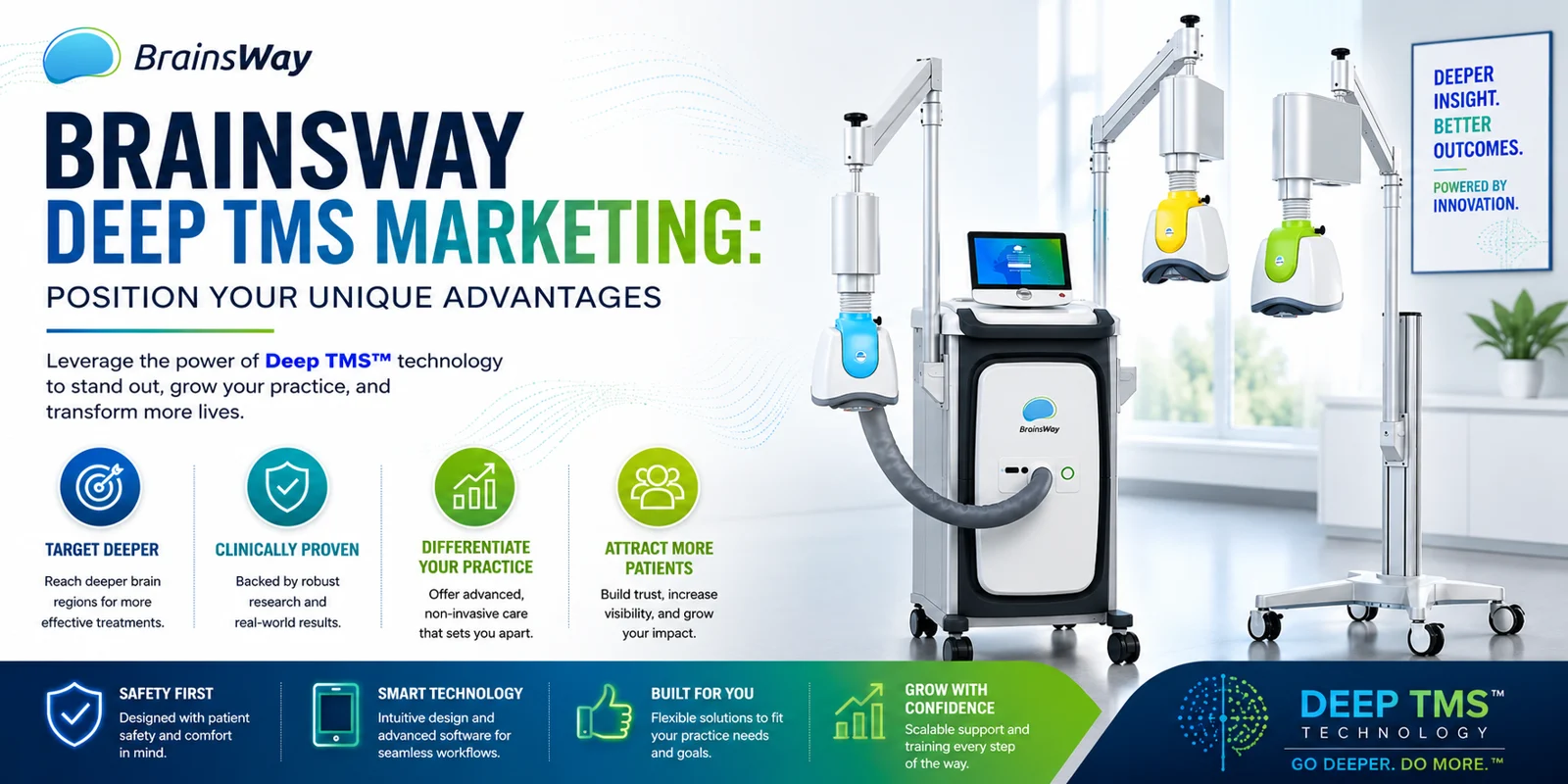
BrainsWay’s Marketable Differentiators
BrainsWay Deep TMS Marketing is now available with Neurovo. BrainsWay holds more unique FDA clearances than any other TMS manufacturer. These aren’t incremental improvements—they’re access to entirely different patient populations.
OCD: The First Non-Invasive Brain Stimulation Treatment
In August 2018, BrainsWay received De Novo FDA clearance for OCD treatment—the first and still only non-invasive brain stimulation device cleared for this indication. This wasn’t a minor regulatory achievement; it was the creation of an entirely new treatment category.
OCD affects approximately 2.3% of the U.S. population at some point in their lives. Standard treatments—SSRIs and exposure-response prevention therapy—help many patients but leave others struggling. Before Deep TMS, patients who didn’t respond to medication and therapy faced limited options: more medication adjustments, intensive residential treatment, or, in severe cases, neurosurgical interventions.
BrainsWay’s H7 coil targets the anterior cingulate cortex and medial prefrontal cortex—brain regions implicated in OCD that standard TMS coils can’t effectively reach. Clinical trials showed 38% of treatment-resistant OCD patients achieved a response, compared to 11% with sham treatment.
For marketing purposes, this exclusivity matters enormously. Any patient searching for “TMS for OCD” should find your practice—because you’re the only TMS option available to them.
Smoking Cessation: The First TMS Clearance in Addiction
In 2020, BrainsWay became the first TMS device FDA-cleared for smoking cessation—opening the addiction treatment market to brain stimulation for the first time. The H4 coil targets the bilateral insula and prefrontal cortex, brain regions involved in craving and addiction.
The clinical data is compelling: the pivotal trial showed a 28.4% quit rate at six-month follow-up compared to 11.7% with sham treatment. For context, nicotine replacement therapy typically achieves 15–20% quit rates, and varenicline (Chantix) achieves around 25–30%. Deep TMS performs comparably to the best pharmacological options without systemic medication.
The marketing opportunity here differs from depression or OCD. Smokers wanting to quit are a massive population—over 30 million Americans smoke, and the majority want to quit. They’re actively searching for solutions. Most have tried patches, gum, and medications without lasting success. Deep TMS offers something genuinely new.
Important consideration: Google requires LegitScript certification for addiction treatment advertising. Smoking cessation may trigger this requirement depending on how you position and target your campaigns. Ensure compliance before launching advertising in this space.
Late-Life Depression: Exclusive Access to Elderly Patients
BrainsWay is the only TMS device with specific FDA clearance for late-life depression in patients aged 68–86. This matters because depression in older adults presents unique challenges: medication side effects are more concerning, drug interactions with existing prescriptions complicate treatment, and elderly patients may be more sensitive to cognitive effects.
Deep TMS for late-life depression offers a non-drug treatment option for a population that often struggles with medication-based approaches. For practices near retirement communities, senior living facilities, or areas with older demographics, this clearance opens a patient population that other TMS devices technically can’t treat.
Deep Stimulation: The Technology Story
BrainsWay’s H-coil technology reaches approximately 4 centimeters into the brain, compared to roughly 2 centimeters for standard figure-8 coils. This deeper penetration is what enables treatment of conditions like OCD, where target brain regions lie beyond the reach of conventional TMS.
For patient-facing marketing, “Deep TMS” is the memorable differentiator. It’s intuitive—deeper sounds are more effective to patients researching options. The technical explanation can follow for those who want it, but “Deep TMS treats what regular TMS can’t reach” communicates the core value proposition.
Target Audiences for BrainsWay TMS Marketing
BrainsWay’s multiple clearances create access to distinct patient populations. Effective marketing treats these as separate campaigns with tailored messaging.
OCD Patients
OCD patients are among the most informed mental health patients you’ll encounter. They’ve typically researched their condition extensively, tried multiple treatments, and connected with OCD communities online. They know about ERP therapy, medication options, and their relative effectiveness.
Marketing to this audience requires sophistication. Surface-level content about “what is OCD” won’t resonate—they know what OCD is. Instead, address their actual questions: How does Deep TMS differ from what they’ve tried? What does the research show? Can they continue current treatments during TMS? How long until they might see improvement?
The OCD community is active online, particularly on Reddit and in Facebook support groups. Authentic participation in these communities—answering questions, providing accurate information, not promotional spam—builds visibility and trust over time.
Channel focus: Google search (high intent), content marketing addressing OCD-specific questions, referral relationships with OCD-specialized therapists, and educational outreach to local IOCDF affiliates.
Smokers Wanting to Quit
Smokers wanting to quit are a fundamentally different audience than mental health patients. They’re not dealing with stigma around their condition. They’re often motivated by concrete factors: health scares, family pressure, pregnancy, cost.
Most have tried to quit before, often multiple times. They’ve used patches, gum, Chantix, and willpower. They’re skeptical that anything will work but still hoping for something that might. The message isn’t “try TMS”—it’s “there’s a new approach you haven’t tried that works differently than what’s failed before.”
Price sensitivity is often higher in this population than in depression patients, since smoking cessation treatment is less commonly covered by insurance. Clear pricing information and payment plan options matter for conversion.
Channel focus: Google search (“stop smoking treatment,” “quit smoking help”), partnerships with pulmonologists and cardiologists, employee wellness programs, health system smoking cessation referrals.
Elderly Patients with Depression
Marketing to elderly depression patients often means marketing to their adult children. Patients in their 70s and 80s may have limited internet engagement, but their family members research options and influence treatment decisions.
The message for late-life depression emphasizes safety and appropriateness: non-drug treatment (no additional medications to interact with existing prescriptions), no systemic side effects, specifically cleared for this age group. Adult children worried about their parent’s medication burden find this positioning compelling.
Channel focus: Referral relationships with geriatricians, senior living facility partnerships, adult children researching on behalf of parents, content addressing depression treatment for elderly patients.
Treatment-Resistant Depression Adults
BrainsWay also treats standard depression—the same core market as other TMS devices. Here, the “deep” positioning provides differentiation: when other TMS hasn’t worked, Deep TMS reaches areas they couldn’t. Whether this technical difference translates to better outcomes is debatable, but for patients who’ve failed conventional TMS, it offers another option.
Condition-Specific Content Strategies
Each indication requires dedicated content, capturing condition-specific searches and addressing condition-specific concerns.
OCD Content
Build comprehensive content targeting OCD searches:
- “Deep TMS for OCD: What the Research Shows” — detailed efficacy data for informed patients
- “TMS vs. ERP for OCD: Understanding Your Options” — addresses the common comparison question
- “Can Deep TMS Help Treatment-Resistant OCD?” — targets patients who’ve failed other treatments
- “What to Expect During Deep TMS OCD Treatment” — reduces anxiety about the unknown
- “Insurance Coverage for TMS OCD Treatment” — addresses the practical barrier
Smoking Cessation Content
Smoking content speaks to a different audience with different concerns:
- “Deep TMS for Smoking Cessation: A New Approach” — introduces the option to skeptical repeat quitters
- “How Brain Stimulation Helps You Quit Smoking” — explains the mechanism in accessible terms
- “Deep TMS vs. Chantix vs. Patches: Comparing Quit Methods” — captures comparison searches
- “What Are the Success Rates for TMS Smoking Cessation?” — addresses efficacy questions with real data
Late-Life Depression Content
Content for elderly patients and their families:
- “TMS for Depression in Seniors: A Medication-Free Option” — addresses medication burden concerns
- “Is Deep TMS Safe for Elderly Patients?” — directly addresses safety concerns
- “Helping Your Aging Parent with Depression” — speaks to adult children researching options
SEO Strategy for BrainsWay Practices
Condition-Specific Keywords
OCD keywords: “TMS for OCD,” “Deep TMS OCD,” “OCD treatment options,” “treatment-resistant OCD,” “non-medication OCD treatment”
Smoking keywords: “TMS quit smoking,” “brain stimulation smoking cessation,” “stop smoking treatment,” “Deep TMS smoking”
Late-life keywords: “depression treatment elderly,” “TMS for seniors,” “depression in older adults treatment”
Brand keywords: “BrainsWay near me,” “Deep TMS [city],” “BrainsWay providers,” “H-coil TMS”
Local SEO for Multiple Conditions
Create location-specific pages for each major indication. “OCD Treatment in [City]” and “Smoking Cessation in [City]” target different searches and different patients. A single generic TMS page misses these condition-specific local searches.
Google Business Profile can highlight multiple services. Use posts to rotate between conditions—one week highlighting OCD treatment, another promoting smoking cessation, another discussing depression in seniors.
Paid Advertising for BrainsWay Practices
OCD Advertising
OCD keywords have less competition than depression terms because fewer practices can advertise for this indication. This often means lower cost-per-click despite smaller search volume. Target searches like “TMS OCD treatment,” “OCD therapy options,” and “treatment-resistant OCD help.”
Ad copy should emphasize the FDA clearance. Specifically, OCD patients researching this space will recognize this as a signal of legitimacy. “First FDA-cleared non-invasive treatment for OCD” is both accurate and differentiated.
Smoking Cessation Advertising
Smoking cessation advertising requires LegitScript certification through Google. Without it, your ads will be disapproved. If you plan to market smoking cessation, obtain certification before investing in campaign development.
The competitive landscape for smoking cessation is different—you’re competing against pharmaceutical companies, nicotine replacement brands, and app-based programs, not just other TMS practices.
Depression Advertising
For depression, BrainsWay competes with all other TMS devices. Differentiate through the “Deep” positioning—deeper stimulation, treating what others can’t reach. This is particularly relevant for patients who mention prior TMS treatment that didn’t work.
Physician Referral Marketing
OCD Specialists
Therapists specializing in OCD—particularly those trained in ERP—see treatment-resistant patients regularly. Deep TMS provides another tool when therapy alone isn’t enough. Outreach to OCD specialists positions you as a collaborative partner, not a replacement for therapy.
Local IOCDF affiliates may offer opportunities for educational presentations. Being known in the OCD treatment community generates referrals from both providers and informed patients.
Pulmonologists and Cardiologists
These specialists regularly counsel patients to quit smoking and see the health consequences when they don’t. Many don’t know TMS is an option for smoking cessation. Educational outreach explaining the FDA clearance and clinical data opens a referral channel that doesn’t exist for other TMS practices.
Geriatricians
Geriatricians managing depressed elderly patients often struggle with medication options—polypharmacy concerns, side effect sensitivity, cognitive impacts. Deep TMS for late-life depression offers an alternative they may not know exists. Materials emphasizing the specific clearance for ages 68–86 and the non-drug nature of treatment speak directly to their clinical challenges.
Leveraging BrainsWay’s Unique Position
BrainsWay practices hold a competitive position that other TMS devices can’t replicate. Exclusive access to OCD treatment, smoking cessation, and late-life depression creates patient populations where you have no direct TMS competition.
The practices that maximize BrainsWay’s potential don’t just market “Deep TMS for depression.” They build separate strategies for each indication, create condition-specific content that captures patients actively searching for solutions, and develop referral relationships with specialists who serve these unique populations.
Generic TMS marketing wastes BrainsWay’s advantages. Patients searching for OCD treatment, smoking cessation, or depression help for elderly parents aren’t looking for generic TMS—they’re looking for solutions to specific problems. Meeting them with specific answers fills treatment chairs.
For a comprehensive TMS marketing strategy, see our TMS Therapy Marketing Complete Guide to track whether your marketing investment is paying off, see How to Measure TMS Marketing Success.
Published by Neurovo — Specialized Marketing for Mental Health Practices Sources: BrainsWay FDA clearance documents, clinical trial data, brainsway.com