
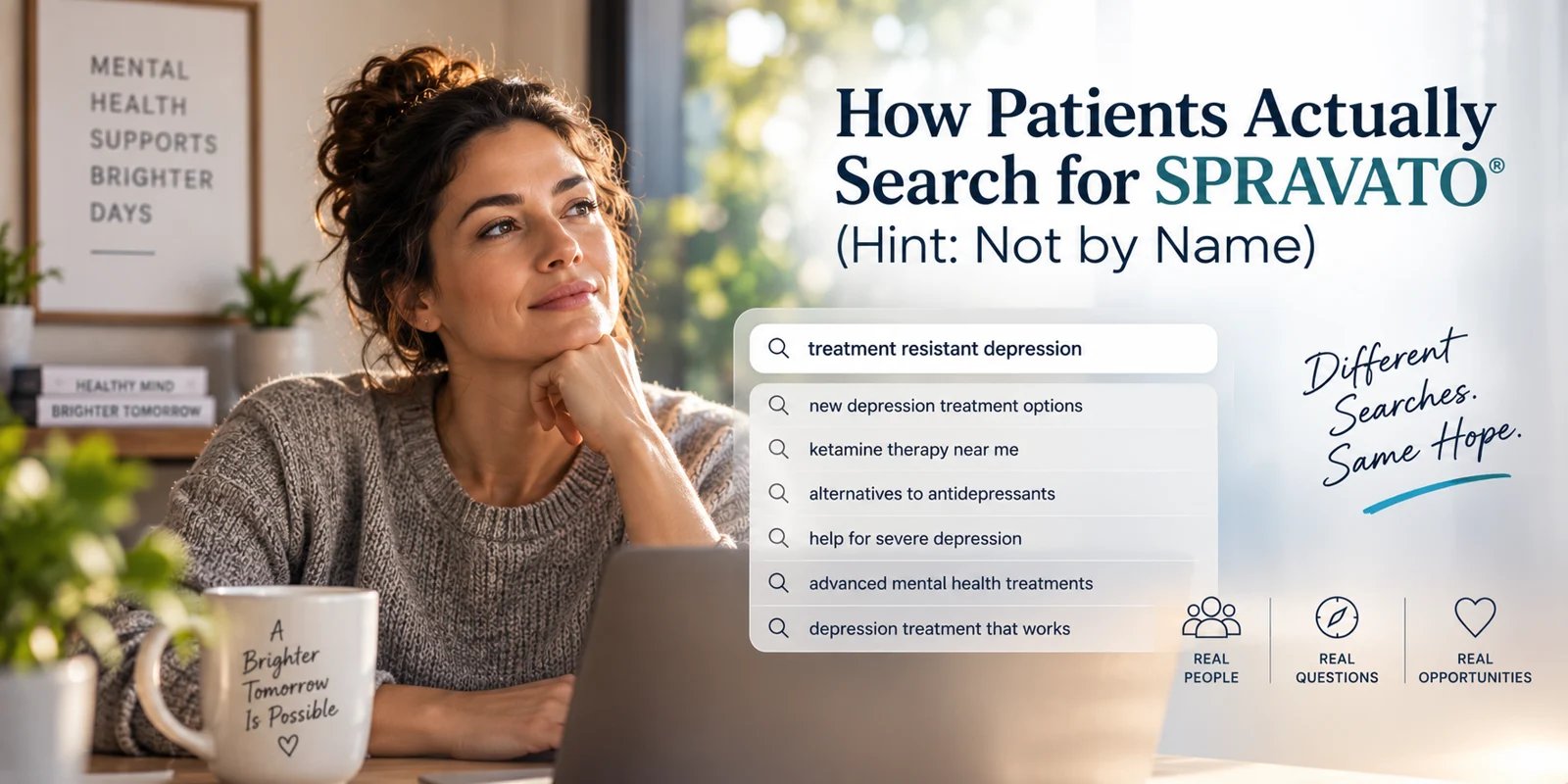
A SPRAVATO® clinic that only builds its SEO and ad strategy around the brand name “SPRAVATO®” is optimizing for a fraction of the people who are actually looking for it.
The brand-recognition gap
SPRAVATO® has been FDA-approved for treatment-resistant depression for several years now, but it’s still a relatively new name to most of the general public — nowhere near the recognition of a decades-old brand. Someone who’s just spent an appointment with their doctor hearing about “an esketamine nasal spray option” doesn’t necessarily walk away remembering the brand name. They remember pieces of it: it’s a nasal spray, it’s related to ketamine, it’s for depression that hasn’t responded to other treatments.
That’s exactly how a meaningful share of prospective patients search — not “SPRAVATO® near me,” but some version of “depression nasal spray,” “ketamine nasal spray for depression,” “esketamine treatment,” or “nasal spray for treatment resistant depression.” Some arrive even less specifically, searching around their symptoms or their frustration with medications that haven’t worked: “what to try when antidepressants don’t work,” “depression treatment options besides medication,” or simply “why isn’t my antidepressant working.”
[INSERT SEMRUSH DATA: pull actual monthly search volume for “SPRAVATO near me,” “depression nasal spray,” “esketamine treatment,” “ketamine nasal spray,” and “esketamine near me” in your target markets, and replace this paragraph with the real numbers. That data point is the single most differentiated thing this article can say — none of your competitors appear to have published it.]
Why this matters for content and ad strategy
A clinic that optimizes only for brand-name terms is fighting for a smaller, more competitive slice of search intent — and often missing the exact moment a prospective patient is doing their first real research. The people searching descriptively, before they know the brand name, are often earlier in their decision process and more receptive to educational content that walks them from “what is this treatment” to “is this right for me” to “how do I get started.”
That has three practical implications. On-page content — service pages, blog articles, FAQ sections — should use the descriptive and colloquial phrasing patients actually type, not just the brand name, and should answer the underlying question directly (what it is, how it’s different from IV ketamine, whether insurance covers it) rather than assuming brand familiarity. Paid search strategy should include a layer of descriptive, non-brand keywords alongside brand terms, since the brand-term pool alone caps how much qualified traffic a campaign can capture. And ad creative — especially on discovery platforms like Meta, where people aren’t actively searching at all — should introduce the treatment in plain language before it ever mentions the brand name, since a headline built entirely around “SPRAVATO®” assumes a level of familiarity most of the audience doesn’t have yet.
Esketamine vs. SPRAVATO®: a distinction worth explaining, not assuming
One more gap worth closing explicitly: SPRAVATO® is the brand name, esketamine is the generic/active-ingredient name — confirmed directly in the drug’s own FDA-approved REMS program materials — and a real number of searchers use the two terms without realizing they’re the same thing. Content that explicitly bridges that gap — “SPRAVATO® (esketamine) is…” stated plainly and early — captures both audiences at once and reads as more credible to anyone doing genuine research, since it signals the writer actually understands the treatment rather than just repeating a brand name.
This same logic extends to how content handles “ketamine” as a search term generally. Because esketamine is chemically related to ketamine, some searchers use the two almost interchangeably even though they’re different substances with different FDA statuses, delivery methods, and insurance treatment. Content that draws this distinction clearly — rather than either ignoring it or leaning into the ambiguity for traffic — builds more durable trust with a reader who’s often already anxious about the “ketamine” association in the first place.
Writing for AI Overviews, not just rankings
Descriptive search behavior matters even more now that a growing share of searches resolve inside an AI-generated overview rather than a traditional list of links. Those systems tend to pull from content that answers one specific question clearly and completely, in plain language, near the top of a section — not from pages that require the reader to already know the terminology to find the right paragraph.
That means content built around this gap should open each relevant section with the question in the reader’s actual words as a heading — “Is a depression nasal spray the same as SPRAVATO®?” rather than a more clinical or brand-forward phrasing — followed immediately by a direct, self-contained answer. It’s a small structural choice, but it’s the difference between content that’s technically accurate and content that actually gets surfaced when someone searches the way they really talk.
Turning this into a content plan, not just a keyword list
Knowing that patients search descriptively is only useful if it changes what gets written. In practice, that means building a small set of dedicated pieces around the actual questions behind those searches, rather than trying to stuff descriptive phrases into content that’s really about something else. A page genuinely answering “what’s the difference between esketamine and IV ketamine” reads differently — and performs differently — than a SPRAVATO® service page that mentions the phrase once in passing.
Worth prioritizing: a direct comparison piece between SPRAVATO® and IV ketamine, written for someone who’s heard both terms and doesn’t know which applies to them; a plain-language explainer on what “nasal spray for depression” actually involves, since the format itself is unfamiliar to most people; and content addressing the “why isn’t my antidepressant working” moment specifically, since that’s often the emotional starting point of the search, well before someone is looking at treatment options by name. None of your current top-three competitors for “SPRAVATO® marketing” appear to have built content around this angle at all — which makes it one of the more genuinely open opportunities in this cluster, not just an incremental improvement on what’s already being done well elsewhere.
The bottom line
The brand name is necessary but not sufficient. Owning “SPRAVATO® marketing” as a search term is one battle; owning the broader set of ways real patients describe this treatment before they know its name is a separate, and in some ways bigger, one. Neurovo builds SPRAVATO® content and campaigns around both — brand terms for people who already know what they want, and descriptive, educational content for the much larger group who are still figuring it out. You can see more of that approach across our blog.
Sources: General search-behavior patterns for newly-branded prescription treatments; SPRAVATO® FDA approval and labeling documentation confirming esketamine as the active ingredient name. Specific keyword volume figures should be sourced from your own SEMrush/Ahrefs account before publication — see the placeholder above.
This article is intended for marketing strategy purposes. Search volume claims should be verified against current keyword research tools before publishing final figures.