
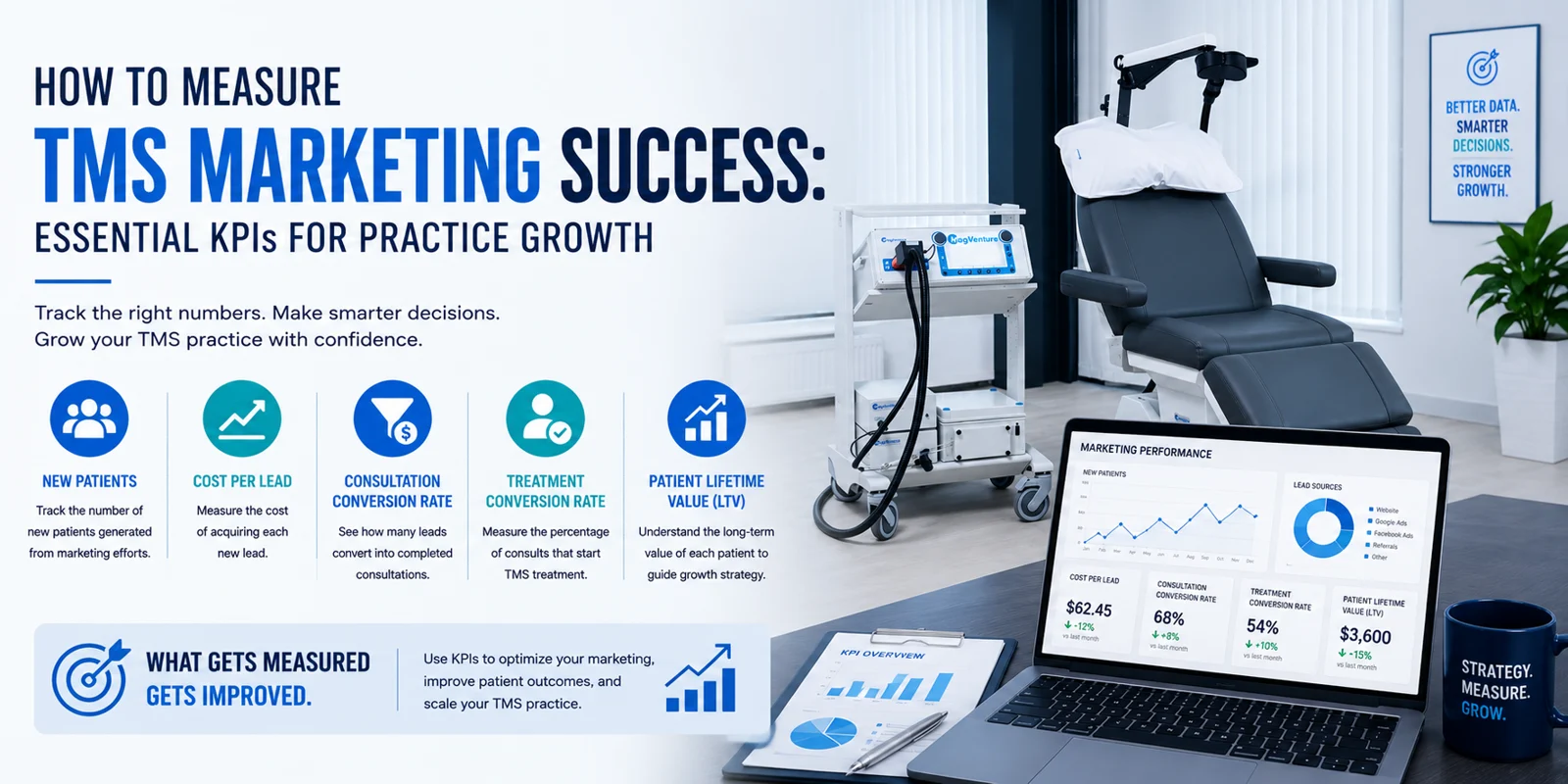
Every TMS practice has a marketing budget. Few actually know if that budget is generating returns.
The problem isn’t lack of data—it’s tracking the wrong data. Website visits look impressive but don’t pay bills. Social media followers feel good but don’t fill treatment chairs. Even leads, that holy grail metric of digital marketing, don’t matter if they never convert to patients.
Effective TMS marketing measurement connects marketing spend to actual revenue. It tracks the patient journey from first click to completed treatment course. It identifies which channels deliver qualified patients and which just create noise.
This guide covers the metrics that matter for TMS practices—from the obvious ones everyone should track to the sophisticated measurements that separate guesswork from strategy. For comprehensive TMS marketing strategies, see our complete guide. [INTERNAL LINK: TMS Therapy Marketing Complete Guide]
The Metrics That Actually Matter
Marketing dashboards can track dozens of metrics. Most of them don’t affect business outcomes. For TMS practices, these are the numbers that connect marketing activity to practice growth.
Cost Per Lead (CPL)
The most basic marketing efficiency metric: how much does it cost to generate an inquiry? Divide total marketing spend by total leads generated.
But this headline number hides important details. CPL varies dramatically by channel. Google Ads might cost $150 per lead while SEO-generated leads cost $30. Facebook might generate $80 leads that never convert while Google delivers $200 leads that become patients at twice the rate. The aggregate number matters less than channel-specific performance.
TMS industry context: Depending on market competitiveness and geography, TMS leads from paid advertising typically range from $100–$300. Highly competitive markets like major metropolitan areas trend higher. Organic leads from SEO and referrals typically cost significantly less but require longer-term investment to generate.
Lead to Consultation Rate
What percentage of people who inquire actually show up for a consultation? This metric exposes problems between marketing and operations.
Low lead-to-consultation rates usually signal one of several issues: slow response time (TMS patients lose interest quickly), inadequate phone handling (untrained staff who can’t answer basic questions or build rapport), insurance barriers discovered late (patients who can’t afford treatment dropping out), or poor lead quality (marketing attracting people who aren’t actually candidates).
Benchmark: Well-run TMS practices convert 40–60% of qualified leads to scheduled consultations. Below 30% indicates a systemic problem worth investigating.
Consultation to Treatment Start Rate
Of patients who come in for consultations, what percentage begin treatment? This conversion point reflects consultation quality, financial discussions, and patient readiness.
Consultations that feel like sales presentations convert poorly. Patients who’ve already tried multiple treatments and been disappointed are sensitive to pressure. Consultations that educate, answer questions honestly, and let patients make informed decisions convert better over time.
Insurance verification before or immediately after consultation dramatically affects this metric. A patient excited about treatment who discovers they have no coverage and face a $10,000+ bill often doesn’t proceed. Surfacing insurance issues early prevents wasted consultation time and sets realistic expectations.
Benchmark: Strong practices convert 50–70% of consultations to treatment starts. Below 40% suggests problems with consultation process, financial discussions, or patient selection.
Cost Per Treatment Start
This is the number that matters most: how much does it cost to acquire a patient who actually starts treatment? Divide total marketing spend by treatment starts, not leads.
Cost per treatment start reveals the true efficiency of your marketing. A channel with expensive leads but high conversion rates might outperform a channel with cheap leads that never become patients. Without tracking this metric, you’re optimizing for the wrong outcomes.
The math: If a full TMS treatment course generates $8,000–$12,000 in revenue (varying by insurance contracts and protocol), and your cost per treatment start is $500–$1,000, you have a sustainable acquisition model. If cost per treatment start exceeds $2,000–$3,000, marketing efficiency needs examination.
Patient Lifetime Value (LTV)
TMS patients aren’t one-time transactions. Many need maintenance treatments after their initial course. Some become patients for other psychiatric services. They refer friends and family. The value of acquiring a patient extends beyond their first treatment.
Calculating LTV requires tracking patients over time: initial treatment revenue, plus maintenance treatment revenue, plus referral value (attributed revenue from patients they send), plus any additional services. This number justifies marketing investments that look expensive when measured only against initial treatment revenue.
Example: Initial treatment: $10,000. Maintenance treatments over two years: $4,000. Two referrals who complete treatment: $20,000. Total LTV: $34,000. This reframes what you can afford to spend acquiring each patient.
Channel-Specific Metrics
Different marketing channels require different measurements. What matters for SEO differs from what matters for paid advertising.
SEO Performance Metrics
Keyword rankings: Track positions for your target keywords, especially local variations like “TMS therapy [city].” Rankings predict future traffic—improving from position 8 to position 3 for a high-volume keyword signals incoming lead growth.
Organic traffic to TMS pages: Overall website traffic matters less than traffic to treatment-related pages. Visitors to your “What is TMS” page are potential patients. Visitors to your careers page may not be.
Organic lead attribution: Use form fields, call tracking, or patient intake questions to identify which leads found you through organic search. This enables calculating SEO-specific cost per lead and comparing to paid channels.
Google Business Profile metrics: Track profile views, direction requests, phone calls, and website clicks from your GBP listing. Local search often drives more TMS inquiries than website organic traffic.
Paid Advertising Metrics
Click-through rate (CTR): The percentage of people who see your ad and click it. Low CTR indicates ad copy or targeting problems. TMS ads typically see 3–6% CTR for well-targeted search campaigns.
Cost per click (CPC): TMS keywords are competitive. Expect $15–$40 per click for core TMS terms in most markets, higher in competitive metros. Branded terms (your practice name, your device name) typically cost less.
Landing page conversion rate: What percentage of clicks become leads? Industry standard for healthcare landing pages is 3–8%. Below 3% suggests landing page problems—unclear messaging, too many form fields, missing trust signals.
Quality Score (Google Ads): Google’s rating of your ad relevance, expected CTR, and landing page experience. Higher Quality Scores reduce cost per click. Improving from QS 5 to QS 8 can cut click costs by 30–40%.
Social Media Advertising Metrics
Cost per lead: Social platforms optimize for various outcomes—ensure you’re optimizing for leads, not engagements. A campaign with great engagement but no leads isn’t helping.
Lead quality: Social leads often require more nurturing than search leads. Track not just lead volume but lead-to-consultation rate by channel. If social leads convert at half the rate of search leads, their true cost is double what it appears.
Video completion rates: For video ads, track how much of your content people actually watch. High drop-off in the first few seconds indicates poor hook. Strong completion rates suggest content resonates.
Building Your Tracking Infrastructure
You can’t measure what you don’t track. Effective TMS marketing measurement requires technical infrastructure connecting marketing activity to patient outcomes.
Call Tracking
Phone calls remain a primary conversion action for TMS practices. Without call tracking, you can’t attribute phone leads to specific marketing channels.
Dynamic number insertion shows different phone numbers to visitors from different sources—search ads see one number, organic visitors see another, social traffic sees a third. Each number routes to your main line but tracks source attribution.
Call recording (with proper disclosure) enables quality assessment. Are phone handlers answering questions effectively? Are they scheduling consultations? Listening to calls identifies training opportunities.
CRM Integration
Marketing data needs to connect to patient data. A CRM system that tracks leads from first contact through treatment completion enables the metrics that matter—cost per treatment start, lifetime value, referral attribution.
Lead source should flow into your CRM automatically from forms, call tracking, and advertising platforms. Manual data entry introduces errors and gaps. Integration matters more than software sophistication.
Intake Form Attribution
Digital tracking catches most attribution, but asking “How did you hear about us?” during intake captures what technology misses. A patient might Google you after their therapist mentioned TMS—the true source was the referral, not the search.
Standardize response categories so data is consistent and analyzable. “Google” is more useful than “online.” “Dr. Smith referral” is more useful than “my doctor.”
Understanding Your Numbers in Context
Metrics without context are just numbers. Understanding whether your performance is good, bad, or typical requires benchmarks.
TMS Marketing Benchmark Ranges
These ranges reflect typical performance across TMS practices. Your market conditions affect where you fall:
- Cost per lead (paid): $100–$300 (varies by market competitiveness)
- Cost per lead (organic): $20–$80 (requires SEO investment amortized over time)
- Lead to consultation rate: 40–60% (below 30% = problem area)
- Consultation to treatment rate: 50–70% (below 40% = problem area)
- Cost per treatment start: $400–$1,200 (sustainable); $1,500+ (needs optimization)
- Website conversion rate: 3–8% of TMS page visitors become leads
Factors Affecting Your Benchmarks
Market competition: Major metros with multiple TMS practices see higher advertising costs and more competitive SEO. Rural areas with limited competition often have lower costs but also smaller patient pools.
Insurance contracts: Practice economics vary based on payer mix. Strong commercial insurance contracts support higher acquisition costs. Practices relying heavily on Medicare or lower-reimbursing plans need tighter marketing efficiency.
Indication mix: Marketing costs differ by patient population. Adolescent patients (NeuroStar only) have less competition. OCD patients (limited devices) are more niche. Smoking cessation (BrainsWay only) has unique market dynamics.
Common Measurement Mistakes
Obsessing over vanity metrics. Website traffic, social followers, and email open rates feel good but don’t directly correlate with practice growth. A practice with 500 monthly website visitors converting at 10% outperforms one with 5,000 visitors converting at 0.5%.
Measuring leads instead of patients. The goal isn’t lead generation—it’s patient acquisition. A channel that generates 100 leads but 2 patients performs worse than one generating 20 leads and 10 patients.
Ignoring the full funnel. Marketing gets blamed for problems that happen after the lead. If lead-to-consultation rates are low, the issue might be phone handling, not advertising. If consultation-to-treatment rates are low, the problem might be financial discussions, not lead quality.
Short-term thinking. SEO takes 6–12 months to show results. Brand awareness builds over time. Practices that kill marketing programs after 60 days of no immediate results never benefit from compounding investments.
Attribution oversimplification. A patient might see your Facebook ad, Google your practice later, read reviews, and call the next week. Crediting only the last touchpoint misses the reality of complex patient journeys.
Building a Measurement Culture
Metrics matter only if you use them. The practices that optimize marketing performance don’t just collect data—they review it regularly, make decisions based on what it shows, and continuously refine their approach.
Monthly marketing reviews should cover: leads by channel, cost per lead trends, conversion rates at each funnel stage, cost per treatment start, and any notable patterns. Quarterly reviews should examine longer-term trends and strategic channel allocation.
The goal isn’t perfect measurement—it’s better decisions. A practice that approximately tracks the right metrics will outperform one that precisely tracks the wrong ones. Start with the fundamentals: cost per lead, conversion rates, cost per treatment start. Build sophistication over time.
For comprehensive TMS marketing strategy including content, SEO, advertising, and referral development, see our complete guide. [INTERNAL LINK: TMS Therapy Marketing Complete Guide]
Published by Neurovo — Specialized Marketing for Mental Health Practices