
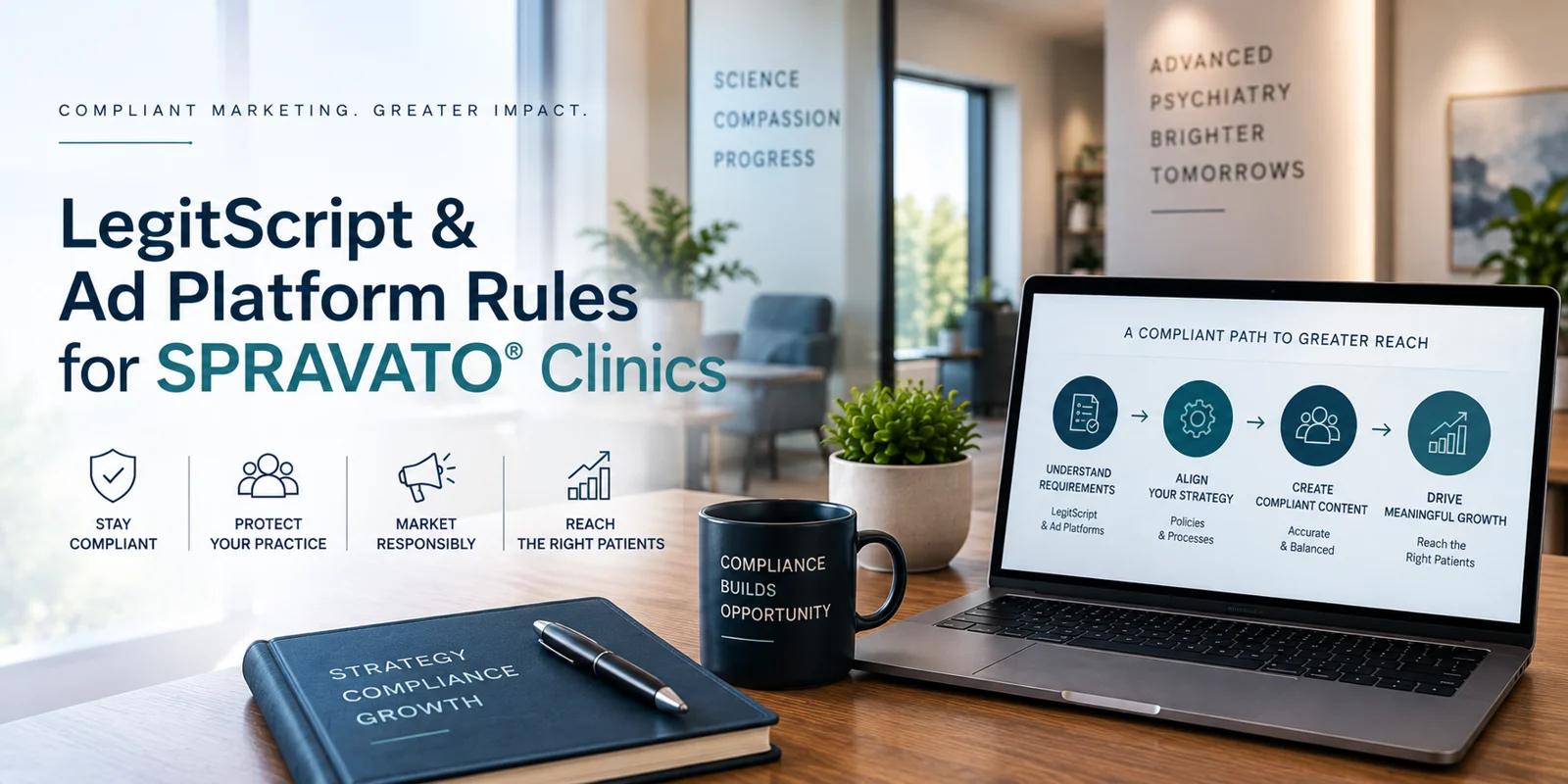
Before a single dollar of SPRAVATO® ad spend goes live, there’s a compliance step most clinics don’t know exists — and skipping it doesn’t just waste budget, it can get an entire account suspended. Because SPRAVATO® is a prescription, Schedule III controlled substance, advertising it on Google or Meta means operating inside a much narrower set of rules than a typical healthcare ad campaign.
Google Ads: certification comes before campaigns
Google’s Healthcare and Medicines policy requires advertisers promoting prescription drugs, telemedicine services, or addiction treatment to be certified — either through LegitScript’s Healthcare Merchant Certification and Monitoring Program or the National Association of Boards of Pharmacy’s equivalent program — and then separately approved by Google itself. This isn’t a formality: without it, campaigns targeting SPRAVATO®-related terms simply won’t run, and healthcare policy violations typically get at least seven days’ warning before suspension, though egregious violations — advertising prescription drugs with no certification at all, for example — can trigger immediate account suspension.
The practical sequence is: get LegitScript-certified first, then apply for Google’s own advertiser certification once that’s in hand. Google’s own guidance notes application review can take several business days on top of whatever time LegitScript’s own review takes. Clinics that try to launch Google Ads campaigns for SPRAVATO® without starting this process weeks in advance are the ones who end up with disapproved ads and a missed launch window.
A few things worth knowing going in: Google’s policy explicitly disallows promoting prescription opioid painkillers under any circumstances, and it also disallows health claims that are false or misleading, or that imply a product is as effective as a controlled substance without appropriate backing. LegitScript reviews aren’t just a rubber stamp — expect them to look closely at whether your site makes guaranteed-outcome claims, whether your privacy policy is genuinely HIPAA-compliant, and whether your business operates transparently. Common reasons applications get delayed include language that reads as a guarantee (“cures your depression” rather than “FDA-approved treatment option”), missing or outdated privacy policy language, and unclear ownership or licensing information on the site. Cleaning these up before applying meaningfully speeds up approval.
Meta: permission is required, and not every clinic qualifies automatically
Meta’s rules are, if anything, stricter. Ads may not promote prescription drugs at all without prior written permission from Meta, and only specific categories of advertiser are even eligible to apply for that permission: online pharmacies, telehealth providers, and pharmaceutical manufacturers. Even once permission is granted, prescription drug ads on Meta can only run in the United States, Canada, and New Zealand, and can’t be targeted to anyone under 18.
This creates a real strategic question for a brick-and-mortar SPRAVATO® clinic that isn’t structured as a telehealth provider: does it clearly fit one of Meta’s eligible categories? That’s not always obvious, and it’s worth a direct conversation with Meta’s Business Help Center — or a compliance advisor familiar with healthcare ad policy — before building a campaign strategy around Meta as a primary channel. Meta has also tightened detailed-targeting options around health-related causes and conditions in recent years, which affects how precisely a campaign can target people based on inferred health interests, separate from the prescription-drug permission question entirely.
In practice, this is a major reason many interventional psychiatry clinics build Meta campaigns around the underlying condition and treatment experience — depression, hope, what recovery looks like — rather than leading with the SPRAVATO® brand name in ad copy. That approach isn’t a documented loophole so much as it’s simply a different, and often more effective, creative strategy: patient education and pattern-interruption content tends to outperform direct product promotion on a platform built for discovery, not search intent.
What about other platforms?
Google and Meta carry the bulk of healthcare ad spend, but they’re not the only platforms with rules here. TikTok allows prescription-medicine ads with proof of approval and certification from the relevant regulator, and treats pharmacy advertisers similarly to Google — LegitScript or NABP certification required. Microsoft/Bing’s healthcare policy is broader and blunter, restricting ads related to sensitive health conditions targeted at consumers. X (formerly Twitter) takes a default-deny approach to health and pharmaceutical advertising, with narrow, explicitly listed exceptions. None of these should be a clinic’s first move without a Google and Meta strategy already working, but it’s worth knowing the landscape before assuming a platform is open simply because it hasn’t been discussed yet.
What this means for your channel mix
Google Ads for SPRAVATO® works, but only for the relatively small pool of people already searching high-intent terms — and it requires certification before a single impression serves. Meta can reach a much larger audience of people who haven’t started looking yet, but only within Meta’s permission structure, and with real constraints on how directly the drug itself can be promoted. Neither channel is “wrong” — but a clinic (or agency) that treats either one like a standard healthcare vertical, without accounting for these specific rules, is going to burn budget on disapproved campaigns before they burn it on underperforming ones.
This is the kind of platform-by-platform compliance work that’s easy to get wrong and expensive to get wrong twice. It’s a core part of how Neurovo builds SPRAVATO® marketing programs, and the same certification-first approach carries across every interventional psychiatry service line we work with — certification handled up front, channel strategy built around what each platform actually allows.
Building certification into the launch timeline
Because certification sits on the critical path, it belongs in the project plan from day one, not as a task discovered mid-launch. A realistic sequence looks like: confirm the clinic’s website and privacy policy are ready for review (no guaranteed-outcome language, HIPAA-compliant privacy language in place), submit the LegitScript application, expect follow-up questions about products, services, or billing practices during their review, then apply for platform-specific certification once LegitScript approval is in hand. Budgeting real weeks — not days — for this sequence before a planned campaign launch date avoids the common failure mode of an ad account sitting in review while a marketing budget sits unspent.
It’s also worth treating certification as an ongoing status, not a one-time achievement. LegitScript and platform certifications can be reviewed periodically, and changes to a clinic’s website, ownership, or services can trigger re-review. Clinics that treat certification as “done” after the first approval sometimes get caught off guard when a routine site redesign or a new service line addition prompts an unexpected compliance check.
The bottom line
LegitScript certification and platform ad approval aren’t paperwork to get around to eventually — they’re the gate a SPRAVATO® campaign has to pass through before it can run at all. Building the timeline for certification into the launch plan, rather than discovering the requirement after ads are already disapproved, is the difference between a campaign that starts on schedule and one that stalls in review for weeks.
Sources:
- Google Ads Healthcare and Medicines policy: support.google.com/adspolicy/answer/16990310
- Google Merchant Center policy on prescription drugs: support.google.com/merchants/answer/6150151
- Meta Ad Standards, prescription drug restrictions: transparency.meta.com/policies/ad-standards/content-specific-restrictions/prescription-drugs
- Meta Ad Standards, drugs and pharmaceuticals: transparency.meta.com/policies/ad-standards/restricted-goods-services/drugs-pharmaceuticals
- LegitScript Healthcare Merchant Certification: legitscript.com
This article is intended for marketing planning purposes and is not legal advice. Ad platform policies change; confirm current requirements directly with Google, Meta, and LegitScript before launching campaigns.