
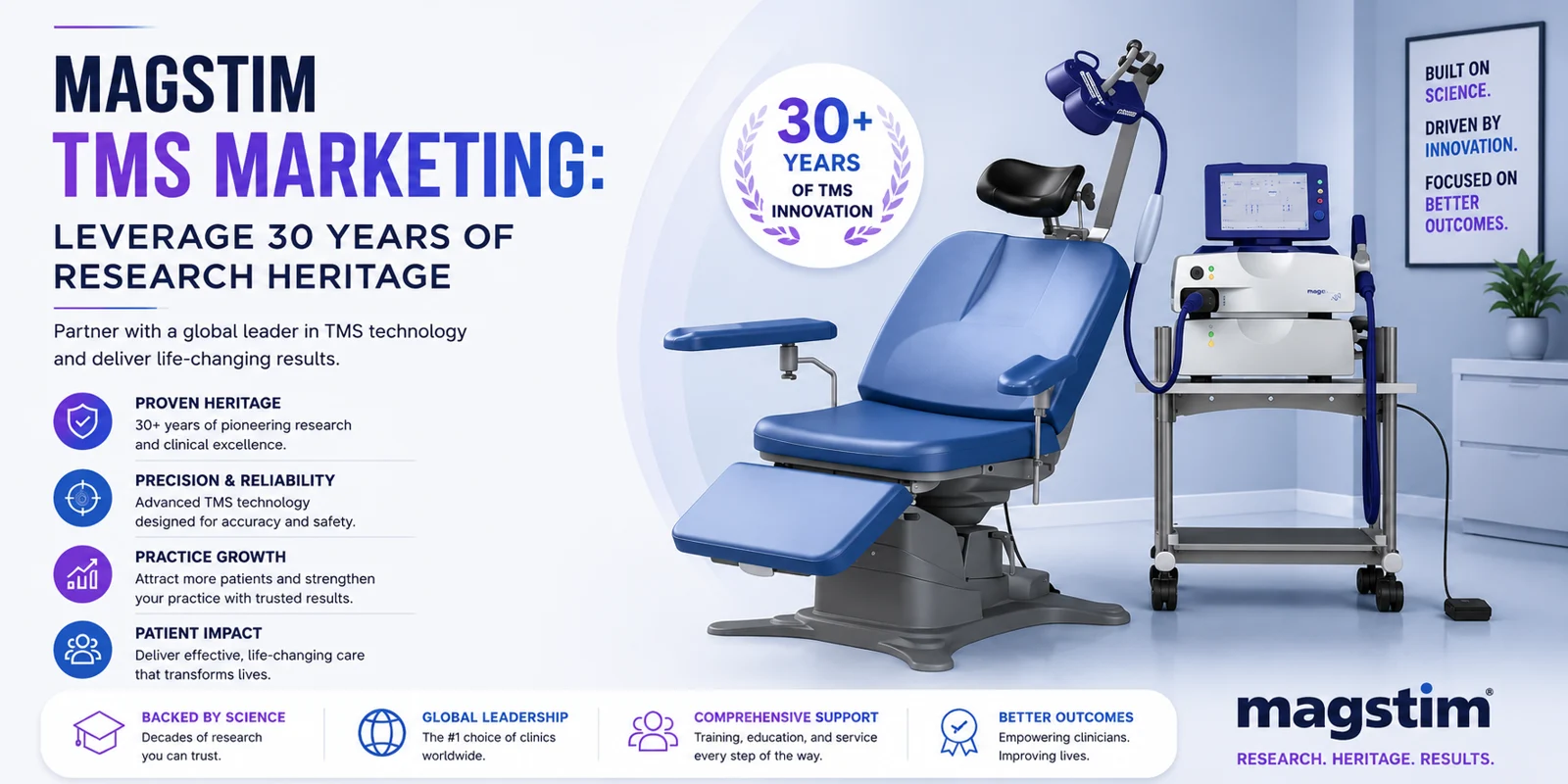
MagStim TMS Marketing is now available at Neurovo. MagStim developed the first commercial transcranial magnetic stimulator over 30 years ago. Before TMS was a clinical treatment—before it was FDA-cleared for anything—researchers worldwide were using MagStim equipment to understand how the brain works.
That research heritage matters. More than 16,000 published studies cite MagStim technology. The foundational science of TMS—the research that proved it worked—was largely conducted on MagStim equipment. When physicians and researchers think about TMS credibility, MagStim’s name carries weight that newer entrants haven’t earned.
This guide covers how to translate MagStim’s research pedigree and technical innovations into marketing that attracts patients and physician referrals. For foundational TMS marketing principles, see our complete guide. [INTERNAL LINK: TMS Therapy Marketing Complete Guide]
MagStim’s Marketable Differentiators
MagStim’s advantages center on research credibility, navigation technology, and practical operational benefits.
The Research Pioneer
MagStim didn’t enter the TMS market—MagStim created the TMS field. The company’s equipment was used in the research that established how TMS affects the brain, which protocols work for different conditions, and why magnetic stimulation produces therapeutic effects.
Over 16,000 published research papers cite MagStim equipment. This isn’t marketing fluff—it’s searchable, verifiable scientific literature. When someone questions the evidence base for TMS, MagStim practices can point to a research library built largely on their device platform.
For physician referrals, this heritage resonates. Doctors trained on TMS research often used MagStim equipment. Neurologists and researchers recognize the name from their academic backgrounds.
StimGuide Pro: FDA-Cleared Neuronavigation
MagStim’s Horizon 3.0 system features StimGuide Pro—the first FDA-cleared navigation system specifically designed for clinical TMS treatment. This isn’t research-grade neuronavigation repurposed for clinical use; it’s navigation built for therapeutic application.
What does navigation mean for patients? Precise targeting. Rather than relying solely on motor threshold measurements and standard head positioning, StimGuide Pro enables accurate, reproducible coil placement based on each patient’s anatomy.
In marketing terms, this becomes messaging around precision: “Precisely targeted to your brain” or “Navigation-guided accuracy.” For patients who’ve failed other treatments, the promise of more accurate targeting can be compelling.
Four Indications, One Coil
MagStim’s Horizon system holds FDA clearances for adult MDD, anxious depression, OCD (adjunct), and adolescent depression—all treatable with the same coil. Unlike some devices that require different coils for different indications, MagStim offers indication flexibility without additional hardware purchases.
Air-Cooled Reliability
MagStim’s air-cooled coil design eliminates the liquid cooling systems required by some competitors. No coolant to maintain, no liquid components to fail, simpler operation. Fewer mechanical components mean fewer potential points of failure, which means more consistent treatment availability.
Magstim Connect Cloud Platform
MagStim’s cloud-connected platform enables remote monitoring, software updates, and data management—resulting in reliability and support that can translate into better treatment experiences.
Target Audiences for MagStim TMS Marketing
Research-Oriented Patients
Some patients do extensive research before treatment decisions. They read studies, evaluate evidence, and want to understand the science. For these patients, MagStim’s research heritage isn’t just marketing—it’s relevant information that influences their confidence in the treatment.
“The device used in 16,000+ research studies” gives these patients something concrete to evaluate. They can actually look up those studies, verify the claim, and draw their own conclusions about the evidence base.
Patients Who’ve Failed Other TMS
For patients who tried TMS elsewhere without success, StimGuide Pro navigation offers a reason to try again. “Previous TMS wasn’t precisely targeted to your specific brain anatomy—ours is.” This positioning gives hope without disparaging their previous provider.
Academic Medical Center Referrals
Physicians at academic medical centers often have research backgrounds and value evidence-based treatments. MagStim’s research heritage resonates with this audience more than with community physicians who may be less connected to TMS literature.
Standard Depression and OCD Patients
MagStim serves the same core markets as other devices—treatment-resistant depression, anxious depression, OCD, adolescent depression. The research heritage and navigation provide differentiation, but the patient populations are familiar.
Positioning the Research Heritage
Evidence-Based Credibility
The 16,000+ studies figure is powerful because it’s specific and verifiable. Use it prominently: “TMS treatment with the equipment behind 16,000+ research publications.” This positions your practice as using research-grade, scientifically validated technology.
For patients skeptical of TMS, the research database provides reassurance. The treatment isn’t experimental or unproven—it’s backed by decades of scientific investigation, much of it conducted with the exact technology in your practice.
Navigation as Precision
StimGuide Pro enables messaging around precision and personalization. “Navigation-guided accuracy” and “precisely targeted to your brain” differentiate from practices using standard positioning methods.
Be careful not to imply that other TMS approaches are imprecise or ineffective—that creates competitor conflict and may not be accurate. Instead, position navigation as an enhancement: “Advanced targeting for optimal precision.”
The Scientist’s Choice
Position MagStim as the choice for those who value scientific rigor. “The TMS technology trusted by researchers worldwide” appeals to patients and physicians who prioritize evidence and expertise over marketing claims.
Content Strategy for MagStim Practices
Blog Topics
Build content around research credibility and navigation precision:
- “The Science Behind TMS: 30 Years of Research” — positions research heritage
- “How Navigation-Guided TMS Improves Treatment Accuracy” — explains StimGuide Pro benefit
- “Why TMS Research Matters for Your Treatment” — connects research to patient outcomes
- “MagStim vs. Other TMS Devices: Understanding Your Options” — comparison content
- “TMS Treatment with Neuronavigation: What Patients Should Know” — targets navigation-curious searchers
Physician-Facing Content
MagStim’s research heritage makes it particularly well-suited for physician referral marketing. Develop materials that speak to the scientific evidence, including specific citations to landmark TMS studies conducted with MagStim equipment.
SEO Strategy for MagStim Practices
Target Keywords
Brand keywords: “MagStim TMS near me,” “MagStim Horizon [city],” “MagStim providers”
Navigation keywords: “TMS neuronavigation,” “navigation guided TMS,” “StimGuide Pro TMS,” “precision TMS treatment”
Research keywords: “TMS research evidence,” “evidence based TMS,” “scientific TMS treatment”
Local SEO
Mention MagStim and navigation capabilities in your Google Business Profile. For practices in academic medical center areas, local SEO connecting research credibility to your location can capture referrals from nearby institutions.
Paid Advertising for MagStim TMS Practices
MagStim brand keywords may have less competition than NeuroStar, offering potentially lower costs for brand-specific campaigns. Navigation-related keywords are also relatively uncontested territory.
Ad copy can emphasize research backing and precision: “TMS backed by 16,000+ studies” or “Navigation-guided precision TMS.” These messages differentiate immediately from generic TMS advertising.
Physician Referral Marketing
MagStim’s research heritage makes physician referral marketing particularly strong. This is the device that neurologists and psychiatrists encountered in their training, in the literature they read, in the research they may have participated in.
Academic Physicians
Physicians with academic appointments value research credibility. Lead with the science: “TMS delivered with the same technology platform used in 16,000+ published studies.” They can verify this claim, and verification builds trust.
Neurologists
Neurologists often have more familiarity with TMS than psychiatrists—they may have used it diagnostically or in research contexts. MagStim’s navigation technology speaks to their appreciation for anatomical precision.
Community Psychiatrists
For psychiatrists less connected to research literature, simplify the message: “30 years of proven technology” and “precision navigation” communicate the core advantages without requiring deep research engagement.
Marketing the Research Standard
MagStim’s position is unique: the company that built the TMS field, whose equipment underlies decades of research, now offering that research-grade technology with clinical navigation. It’s not the biggest name in TMS marketing, but for practices that value scientific credibility and precision, it’s a compelling story.
Effective MagStim marketing doesn’t compete on market share or flashy claims. It competes on substance: verifiable research heritage, FDA-cleared navigation, and the credibility that comes from being the equipment scientists trust.