
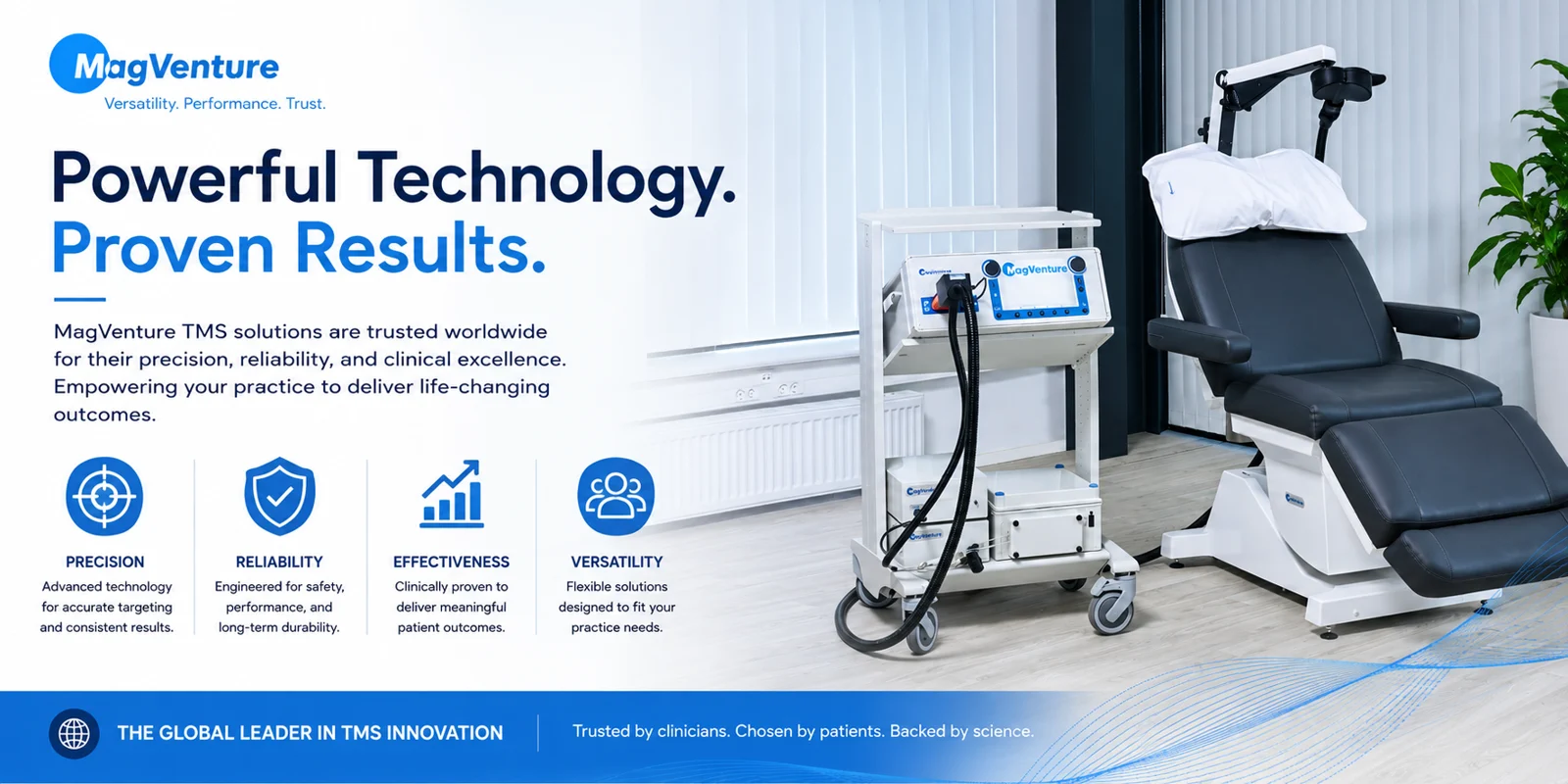
Let Neurovo help you with your MagVenture TMS marketing. We are experts in marketing TMS for interventional psych practices nationwide.
“I can’t take time off work every day for six weeks.”
This objection kills more TMS treatment plans than insurance denials. Working professionals, parents juggling schedules, people whose lives don’t accommodate 45-minute daily appointments—they need TMS but can’t make traditional protocols work.
MagVenture’s Express TMS changes that equation. Three-minute sessions instead of 37 minutes. Treatment that fits in a lunch break instead of consuming an afternoon. The same clinical efficacy demonstrated in the landmark THREE-D trial, condensed into a protocol that busy patients can actually complete.
This is MagVenture’s core marketing story: TMS that works for real lives. For foundational TMS marketing principles, see our complete guide.[TMS Therapy Marketing Complete Guide]
MagVenture’s Marketable Differentiators
MagVenture’s advantages center on time efficiency and clinical validation. In a market where most devices offer similar depression treatment, these differentiators create real positioning opportunities.
Express TMS: 3-Minute Sessions
MagVenture was the first TMS company to receive FDA clearance for intermittent theta burst stimulation (iTBS) in 2018. The MagVita system’s Express TMS protocol delivers a full treatment session in approximately 3 minutes—compared to 19–37 minutes for conventional TMS protocols.
Three minutes. That’s the time between meetings. That’s a coffee break. That’s stopping by on the way to work. For patients whose primary objection to TMS is the time commitment, Express TMS removes the barrier entirely.
The marketing message writes itself: “TMS that fits your life.” “Depression treatment in 3 minutes.” “Lunch break TMS.” These aren’t gimmicks—they’re accurate descriptions of a protocol that makes treatment accessible to people who couldn’t otherwise commit.
THREE-D Trial: Landmark Clinical Validation
The THREE-D trial, published in The Lancet in 2018, established that iTBS produces equivalent outcomes to conventional TMS protocols in a fraction of the time. This wasn’t a small study—it enrolled 414 patients across multiple Canadian sites in a rigorous non-inferiority design.
Using MagVenture equipment, the trial demonstrated that 3-minute iTBS sessions were non-inferior to 37-minute conventional sessions. Response rates, remission rates, and durability of response were statistically equivalent.
For physician referrals especially, the THREE-D trial provides credibility. Published in The Lancet—one of the most prestigious medical journals—it represents the gold standard of clinical evidence.
Liquid Cooling: Operational Efficiency
MagVenture’s liquid-cooled coils enable back-to-back patient treatments without waiting for equipment to cool down. With 3-minute sessions and no cooling delays, a single MagVenture system can treat significantly more patients per day than conventional TMS setups.
This throughput enables practices to offer more appointment availability—which itself becomes a marketing advantage through shorter wait times and flexible scheduling.
OCD Clearance
MagVenture received FDA clearance for OCD as an adjunct treatment in 2020. For practices in markets without BrainsWay providers, this creates an opportunity to capture OCD patients searching for TMS treatment.
Target Audiences for MagVenture TMS Marketing
Express TMS’s time efficiency creates natural audience segments based on schedule constraints.
Working Professionals
Executives, professionals, and anyone with demanding work schedules often can’t disappear for an hour every day. Three-minute sessions change the calculation. Early morning appointment before work. Quick stop during lunch. End-of-day session that doesn’t delay getting home.
The message to this audience: effective treatment that doesn’t require restructuring your professional life.
Targeting approach: LinkedIn advertising to professional demographics, partnerships with employee assistance programs (EAPs), content addressing depression treatment for busy professionals, emphasis on discretion and minimal work disruption.
Parents and Caregivers
Parents juggling childcare, school pickups, and family logistics face similar time constraints. Express TMS fits into the margins. Drop kids at school, quick treatment, back before pickup. The message emphasizes that treating their depression doesn’t mean sacrificing family responsibilities.
Targeting approach: Facebook/Instagram targeting parents in your geographic area, content addressing parental depression and treatment challenges.
Patients Who’ve Avoided TMS Due to Time
Some patients already know about TMS but ruled it out because of the time commitment. They’re pre-educated on the treatment—they just need to learn that a faster option exists.
Content addressing “short TMS sessions” or “quick TMS treatment” captures this audience. They’re not starting from zero; they need to know the barrier they identified has been removed.
Positioning Express TMS Effectively
Time efficiency is compelling, but it can raise questions if positioned poorly. Patients might wonder: “Is shorter treatment as effective? Are they rushing through it?”
Leading with Efficacy
The THREE-D trial’s Lancet publication provides the credibility to answer efficacy questions. The message isn’t “TMS but faster”—it’s “proven effective TMS that also happens to be faster.” Lead with clinical validation, then introduce the time benefit.
“Express TMS delivers the same clinical outcomes as standard protocols in 3 minutes instead of 37. Published in The Lancet, the THREE-D trial proved that theta burst stimulation is just as effective—in a fraction of the time.”
Addressing Skepticism
Some patients and physicians will be skeptical that shorter could be equivalent. Address this directly:
“You might wonder how 3 minutes can equal 37 minutes. The answer is in the stimulation pattern. Theta burst stimulation delivers pulses in a specific rhythm that efficiently activates brain plasticity. Research across multiple studies shows this approach is as effective as longer conventional protocols.”
The Lifestyle Angle
Once efficacy is established, lean into lifestyle benefits. “Treatment that fits your life” resonates because it acknowledges that patients have lives, responsibilities, and constraints.
Content Strategy for MagVenture Practices
Blog Topics
Build content around the speed advantage and the clinical validation:
- “Express TMS: Depression Treatment in 3 Minutes” — the core value proposition
- “The THREE-D Trial: What It Means for TMS Patients” — clinical credibility content
- “iTBS vs. Standard TMS: Understanding Your Options” — comparison content for researching patients
- “TMS Treatment for Busy Professionals” — targets working audience specifically
- “Can I Get TMS on My Lunch Break?” — addresses literal question patients ask
Video Content
Video works exceptionally well for Express TMS marketing because you can actually show how quick it is. A real-time video of a 3-minute session—start to finish—is more convincing than any written description.
Patient testimonials from working professionals discussing how Express TMS fit into their schedules provide social proof from relatable sources.
SEO Strategy for MagVenture Practices
Target Keywords
Speed-focused keywords: “Express TMS,” “fast TMS treatment,” “quick TMS sessions,” “3-minute TMS,” “theta burst TMS”
Brand keywords: “MagVenture near me,” “MagVenture TMS [city],” “MagVita TMS”
Audience keywords: “TMS for busy professionals,” “depression treatment working parents,” “TMS lunch break”
Research keywords: “THREE-D trial TMS,” “iTBS research,” “theta burst depression”
Local SEO
Your Google Business Profile should highlight Express TMS capability. Include it in your business description, mention it in posts, and respond to reviews that specifically mention the convenience.
Paid Advertising for MagVenture Practices
Google Ads
Bid on “Express TMS” and iTBS-related terms where competition is lower than generic TMS keywords. Ad copy emphasizing “3-minute sessions” differentiates immediately from competitors whose ads all say similar things about depression treatment.
Test headlines like “Depression Treatment in 3 Minutes” against more conventional “FDA-Cleared TMS Therapy.” The time-focused message may resonate more with audiences whose barrier is scheduling.
Social Advertising
LinkedIn enables targeting professionals by job title, seniority, and industry—reaching executives and professionals who are exactly the audience most likely to value 3-minute sessions.
Facebook and Instagram can target by demographics and interests that correlate with busy schedules—parents, professionals, people expressing interest in productivity and time management topics.
Physician Referral Marketing
Psychiatrists
Present Express TMS as a compliance solution. The psychiatrist’s treatment-resistant patient who “can’t commit to TMS” due to schedule constraints now has an option. Positioning Express TMS as expanding access—rather than replacing conventional TMS—frames it as additional capability.
Primary Care Physicians
PCPs managing depression patients often hear scheduling concerns when suggesting any treatment requiring regular appointments. Having the THREE-D trial data—published in a journal they respect—supports the credibility of referring patients to a faster protocol.
Making Time Work for You
MagVenture’s Express TMS solves a real problem that prevents real people from getting treatment. The 3-minute session isn’t a marketing gimmick—it’s a clinical advancement supported by rigorous research that removes one of TMS’s biggest barriers to adoption.
Practices that market this advantage effectively attract patients who otherwise wouldn’t pursue TMS at all. They’re not stealing patients from competitors—they’re expanding the addressable market to include people whose schedules made treatment impossible.
Lead with efficacy, then convenience. The THREE-D trial establishes that Express TMS works. The 3-minute sessions establish that it fits real lives. Together, they tell a story that fills treatment chairs.