
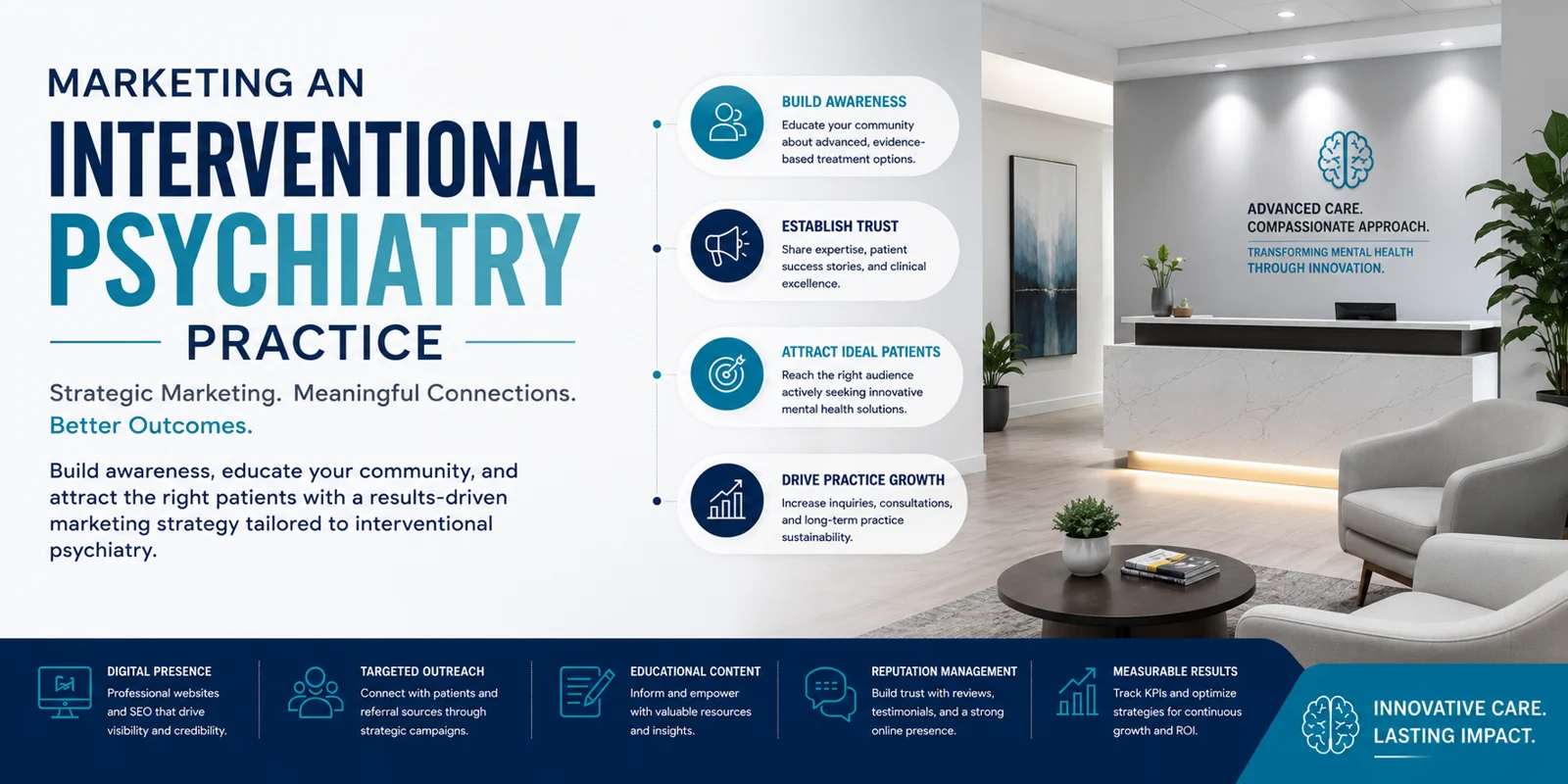
Marketing an Interventional Psychiatry Practice: A Strategic Guide
Consider a practice that offers ketamine, TMS, and Spravato. Three evidence-based treatments for the same underlying population — patients whose depression hasn’t responded to standard care. The practice hires a TMS manufacturer’s preferred agency for TMS marketing, brings on a generalist healthcare agency for ketamine campaigns, and manages Spravato internally because no one quite knows who handles that. Three separate agencies, three separate Google Ads accounts, three separate sets of landing pages, three completely different brand voices — all targeting the same patient.
When those three accounts bid on overlapping keyword territory, they’re competing against each other in the same auction. Each one is paying for impressions on keywords the other two also want. CPC goes up. Impression share gets fragmented. And when a patient who has failed three antidepressants searches “depression treatment that actually works” and clicks one of the three ads, she lands on a ketamine-specific page that has no idea TMS or Spravato exist, from a practice that has no coherent story about what it does or who it helps.
This is not a hypothetical. It is one of the most common structural failures in interventional psychiatry marketing — and it happens almost entirely because practices think about marketing one modality at a time.
The Multi-Modality Marketing Problem
Interventional psychiatry practices accumulate their service offerings incrementally. A psychiatrist adds TMS. Later, ketamine. A few years after that, REMS certification for Spravato. Each addition makes clinical sense. Each one is also managed in isolation — because when you add a treatment, the natural instinct is to find someone who markets that treatment, not to rethink the entire marketing architecture.
The result is a fragmented system. Different campaigns pull in different directions. Budget is split across accounts that were never designed to work together. The machine learning algorithms that govern Google’s Smart Bidding and Meta’s delivery optimization need consolidated data to perform — scatter that data across three separate accounts or three separate campaigns with overlapping keywords, and every algorithm is working with less information than it needs. Performance suffers in ways that are genuinely difficult to diagnose, because none of the three accounts can see what the other two are doing.
The patient experience reflects this fragmentation. A patient considering treatment options for depression that hasn’t responded to medication may encounter a TMS ad on Tuesday, a ketamine ad on Friday, and stumble across a Spravato page through organic search the following week — all from the same practice, none of which acknowledges the others exist. The practice has three treatments and no story.
The agency fragmentation problem compounds everything. A generalist agency working on ketamine doesn’t know TMS is offered. The TMS manufacturer’s preferred marketing partner has no experience with off-label controlled substance advertising requirements. No one is looking at the full picture, because no one has been given the full picture to look at.
Treatment-Resistant Depression as the Strategic Foundation
The most important marketing insight for a multi-modality interventional psychiatry practice is one that has nothing to do with marketing: every patient who walks through the door shares the same clinical context. They have been in treatment. They have tried medications. The medications have not worked. That is the unifying condition across ketamine, TMS, and Spravato — not the treatments themselves, but the treatment failure that precedes them.
This matters enormously for marketing strategy, because patients do not search for treatments they don’t know about. They search for answers to the problem they’ve been living with. “Why doesn’t my antidepressant work.” “Depression treatment when nothing helps.” “Treatment-resistant depression options near me.” These searches outnumber modality-specific queries by a significant margin, and they represent patients who are equally appropriate for ketamine, TMS, or Spravato — depending on clinical factors that belong in the consultation, not in the ad.
A practice that organizes its marketing around treatment-resistant depression captures this larger upstream population. A practice that runs three separate modality campaigns captures only the patients who already know what they want — a meaningfully smaller group.
The content implication is substantial. TRD-focused content — what treatment-resistant depression is, why peer-reviewed research estimates it affects approximately 30% of medication-treated MDD patients among the estimated 21 million Americans living with major depressive disorder, what the treatment options are and how they differ — outperforms individual modality content in both search volume and conversion quality. Patients who arrive at a consultation having already read a thorough, honest explanation of TRD and the treatment landscape tend to be more prepared, more realistic about outcomes, and more ready to commit to a treatment plan.
The brand implication is equally important. A practice that positions itself as a specialist in treatment-resistant depression — rather than a clinic that happens to offer TMS and ketamine — is describing its clinical identity, not its equipment list. That framing earns referrals from psychiatrists who have refractory patients and want a trusted destination. It earns organic search traffic from patients who don’t yet know any of these treatments exist. And it gives the practice a coherent story that holds together across every channel, every ad, and every patient conversation.
What “Interventional Psychiatry” Means — and Why It Matters for Marketing
The term “interventional psychiatry” has significant value as a positioning and professional identity concept. It accurately describes a clinical orientation — a practice that applies procedural and device-based treatments to psychiatric conditions — and it signals credibility to referring providers and clinically sophisticated patients.
Patients do not search for it.
This creates a specific two-layer challenge. The practice wants to be known as an interventional psychiatry practice because that accurately describes what it does and how it thinks about treatment. The patients it needs to reach are searching in a completely different vocabulary — symptoms, diagnosis names, treatment failures, specific modalities they’ve heard about from a friend or in a news article.
Managing this well requires intentional strategy rather than a single choice. “Interventional psychiatry” belongs prominently in the practice’s professional identity: on the website’s about page, in referral materials sent to psychiatrists and PCPs, on LinkedIn, in any earned media or speaking presence. It is the right language for provider-to-provider communication.
For patient-facing search, the language must follow patient behavior. The SEO and paid search strategy targets how patients actually search: condition-based queries for TRD and failed medications, modality-specific queries for patients further along in their research, and local queries for patients who are ready to schedule. The brand narrative on landing pages can explain that the practice specializes in interventional psychiatry — but it must earn that explanation by first meeting the patient where they are.
Building a Unified Channel Strategy
Google Ads — One Account, Organized Around Intent
The fundamental structural requirement for a multi-modality IP practice is a single Google Ads account that covers all modalities, built around patient intent rather than treatment category.
This matters for two reasons. First, if modalities are managed across separate accounts — particularly by separate agencies — those accounts enter the same auctions as competitors. CPCs go up. Budget efficiency goes down. Second, even within a single account, campaigns with overlapping keywords fragment impression share and split the data each campaign uses to optimize. The solution is a unified account with a clear keyword architecture: no duplication, coordinated negative keyword lists that prevent campaigns from cannibalizing each other, and budget allocated based on funnel position and intent signal.
The keyword structure for an IP practice operates in tiers. The upstream tier targets TRD and antidepressant-failure language — patients who are in active distress but haven’t committed to a specific treatment. The mid-tier captures patients who are aware of one of the modalities and are evaluating options. The bottom tier captures high-intent branded and location searches. Each tier has different cost characteristics, different conversion rates, and different messaging requirements — and they all belong in a single coordinated account that can see the full picture.
Compliance applies uniformly. LegitScript Healthcare certification and Google Healthcare Advertiser Verification are required for ketamine, TMS, and Spravato advertising. A practice that has completed this process for one modality has completed it for all — the certification covers the account, not the individual service line. For practices that haven’t yet gone through this process, it is the prerequisite step before any campaign launches across any modality.
Meta Ads — The Awareness Layer Before the Search
Meta operates at a fundamentally different point in the patient funnel than Google. The patient searching Google for “ketamine therapy near me” is already aware, already in-market, and actively making a decision. The patient scrolling Instagram who will eventually search for that same phrase hasn’t made that connection yet.
Meta’s value for a multi-modality IP practice is reaching that second patient — before she’s in-market — and building enough familiarity with the practice that when she does search, the name she’s seen is the one she clicks.
The creative strategy for a multi-modality practice should lead with the patient’s problem, not the practice’s treatments. An ad that speaks to the experience of failed antidepressants and the existence of evidence-based alternatives reaches a wider, more relevant audience than any modality-specific ad can. It also avoids the platform policy issues that arise from making health condition claims in targeted advertising — Meta restricts targeting based on health conditions, so the compliant approach uses broad demographic and geographic targeting, not condition-specific interest audiences.
Meta CAPI (Conversions API) is non-negotiable. It applies equally across all three modalities and should be implemented as a single server-side infrastructure that covers the entire practice’s advertising footprint. This is not a campaign-level decision — it is an account-level architecture decision that requires a properly configured server-side tagging setup and a signed Business Associate Agreement from every vendor handling patient data.
Sequential messaging — awareness, then treatment education, then action — is the Meta framework that produces results for IP practices. Each step in the sequence serves a different patient intent and requires different creative thinking. Building this sequence requires more upfront planning than most practices invest, which is why most IP practices on Meta run a single generic ad and wonder why it doesn’t convert.
Referral Marketing — The Channel Where Multi-Modality Is a Competitive Advantage
A single-modality practice has one answer for a referring physician’s refractory patient. A multi-modality practice can match the patient to the right treatment, rather than the only treatment on offer.
For referring providers — psychiatrists, primary care physicians, therapists, hospital discharge planners — this is a meaningful distinction. It means fewer referral hand-offs, fewer lost-to-follow-up patients, and a trusted single destination for their most complex cases. The multi-modality practice’s referral pitch is not “we offer three treatments.” It is “we specialize in patients for whom standard care hasn’t worked, and we have the tools to address that across multiple evidence-based options.”
A referral packet for a multi-modality IP practice should be a single document — not three separate documents for each service. It should position the practice as a TRD specialist, explain which patients are appropriate to refer (failure to respond to at least 2 antidepressants is the consistent clinical threshold across all 3 modalities), describe what happens after a referral, and include a named contact. It should fit on one page. The referring provider is busy. Complexity kills referral relationships.
The referring provider categories worth developing systematically: psychiatrists managing refractory patients, primary care physicians frustrated by the limits of their antidepressant formulary, therapists working with clients who have been medication-resistant for years, and hospital inpatient psychiatric units for whom discharge planning involves identifying next-step outpatient options for the most difficult cases.
SEO and the Content Cluster Architecture
The SEO strategy for an IP practice follows the same unified logic as the paid strategy: build content authority around treatment-resistant depression as the hub, with modality-specific content clusters as the spokes.
A TRD hub article — what it is, who it affects, what the treatment options are and how they compare — captures the upstream search volume that no individual modality article can touch. From that hub, patients navigate into ketamine-specific content, TMS-specific content, or Spravato-specific content depending on what they’re evaluating. Internal links between the clusters signal topical authority to search engines and give patients a natural pathway to explore.
This architecture takes time to build and takes longer to rank. It also doesn’t stop working when ad spend stops. A practice that consistently invests in this content structure for 12 months is building a patient-acquisition asset that compounds and a competitor cannot replicate quickly. In a space where most practices have either no content or a handful of thin service pages, a genuine content cluster is a meaningful competitive differentiator.
Positioning Multiple Modalities Without Confusing Patients
Practices that try to explain all three modalities in the first sentence of their homepage confuse patients. Practices that pick one modality to lead with and bury the others do not serve patients who might benefit from a different option. Getting this right requires thinking about the patient’s decision-making process, not the practice’s service menu.
At the top of the funnel — in ads, in general educational content, in the first impression a patient has of the practice — the message should be about the problem, not the solution. The practice helps people whose depression hasn’t responded to standard treatment. That framing is inclusive of all three modalities and immediately relevant to the patient who qualifies.
The consultation is where treatment selection happens. Marketing should move a qualified patient to that consultation efficiently — not pre-sell a specific treatment in a way that locks the patient into an expectation before a clinician has assessed them. This has direct implications for copy and call-to-action language: the goal is to get the right patient in front of the right clinician, not to close a treatment decision that belongs in a clinical conversation.
Comparison content serves an important function in this middle space. An honest, clinically accurate article comparing ketamine, TMS, and Spravato for treatment-resistant depression — one that doesn’t reach a predetermined conclusion — builds more trust than any promotional page can. Patients do this research. A practice that provides it transparently, and that describes each treatment accurately with correct regulatory language (FDA-cleared for TMS, FDA-approved for Spravato, off-label for ketamine infusions), signals clinical sophistication and earns the inquiry it’s trying to convert.
Compliance Across a Multi-Modality Practice
Each modality in an interventional psychiatry practice carries its own regulatory context. A unified marketing strategy still has to navigate each one correctly.
Ketamine infusions for depression are off-label — the FDA approves ketamine as an anesthetic agent, and its use for depression, anxiety, and PTSD is not an FDA-approved indication. This constrains advertising language throughout. “Proven,” “FDA-approved for depression,” and outcome guarantees are all off the table. What’s appropriate: accurately describing ketamine as administered by licensed medical professionals for treatment-resistant depression, with evidence from peer-reviewed clinical literature.
TMS devices are FDA-cleared through the 510(k) clearance pathway — not FDA-approved, which is the process for pharmaceutical drugs. The first TMS device was cleared for major depressive disorder in 2008. Since then, cleared indications have expanded across manufacturers and devices to include OCD, anxious depression, smoking cessation, and migraine — but these clearances are device-specific. A practice should describe only the cleared indications that apply to the specific device it operates, and should use “FDA-cleared” throughout, never “FDA-approved.”If you are primarily marketing TMS, you can read our informative guide here.
Spravato (esketamine) carries FDA approval — a drug approval, not a device clearance — for treatment-resistant depression in adults (originally March 2019; as a monotherapy since January 21, 2025) and for depressive symptoms in adults with MDD and acute suicidal ideation or behavior (August 2020, still requires concurrent oral antidepressant). The monotherapy approval applies specifically to the TRD indication. These distinctions belong in every piece of marketing copy that references Spravato’s regulatory status.
HIPAA compliance is not modality-specific — it applies uniformly across the entire practice’s marketing infrastructure. A single server-side tracking implementation, a single set of Business Associate Agreements with every marketing vendor, and a single compliance audit covers all three modalities. This is one area where a unified approach is not just strategically superior — it is operationally simpler.
LegitScript Healthcare certification and Google Healthcare Advertiser Verification apply at the business and website level. A practice operating a single website that covers all three modalities typically completes one LegitScript certification that covers all services on that site. Practices that operate separate websites for individual service lines may need to submit additional applications for each. Either way, the compliance investment is made once per website — not once per modality — and a practice that has already completed this process for one service has the infrastructure in place to extend it efficiently.
Measuring Performance Across Modalities
Attribution in a multi-modality practice is more complex than in a single-modality practice, and acknowledging that complexity is the prerequisite for measuring anything accurately.
A patient who converts to TMS may have clicked a ketamine ad three weeks earlier. A patient who ultimately receives Spravato may have started her research on a TRD blog post via organic search, then clicked a Meta ad, then found the practice’s Google Business Profile on the day she called. Standard last-click attribution assigns full credit to the last touchpoint and misrepresents every step before it. In a multi-modality practice where the funnel involves multiple touchpoints across multiple channels and multiple treatment options, last-click data actively misleads budget decisions.
A server-side setup with proper UTM parameters and a CRM that captures both first-touch and last-touch source gives a directionally accurate picture — not perfect, because attribution never is, but sufficient for informed decisions about where to invest and where to pull back. The goal is not perfect attribution. It is attribution that’s accurate enough to make better decisions than a practice running on gut instinct and last-click reports.
The metrics that matter for a multi-modality IP practice are consistent with any single modality: cost per qualified inquiry, cost per scheduled consultation, consultation-to-treatment conversion rate, and patient lifetime value. The multi-modality version of patient lifetime value is often meaningfully higher than practices realize — a patient who receives TMS for an initial episode and later presents with a different clinical picture may be a strong candidate for ketamine or Spravato. A practice that tracks patient relationships longitudinally, not just per-modality conversion events, has a clearer picture of its actual return on marketing investment.
One useful organizing principle: measure by intent tier, not by campaign. A TRD-focused upstream campaign will have a different cost per consultation than a branded bottom-funnel campaign — not because one is underperforming, but because they serve different stages of the same funnel. Holding them to the same CPC or conversion rate benchmark misreads what each campaign is supposed to accomplish.
About Neurovo
Neurovo is a digital marketing agency that works exclusively with interventional psychiatry practices — ketamine clinics, TMS providers, Spravato-certified practices, and multi-modality psychiatric groups across the United States. The agency’s work spans patient acquisition strategy, HIPAA-compliant tracking infrastructure, LegitScript certification management, and content development for practices at every stage of growth.
Neurovo has developed marketing systems for more than 350 practices in this vertical. Its work is limited to the interventional psychiatry space — a deliberate focus that shapes the depth of expertise reflected in its published resources and client work.
For multi-modality practices looking to consolidate their marketing or build a patient acquisition system that works across all their services, Neurovo offers an initial strategy consultation. Contact us today.
The information in this article is intended for educational and informational purposes and does not constitute legal, compliance, or medical advice. Regulatory classifications, platform policies, and FDA clearance and approval designations are subject to change and vary by device and indication. Verify current status with primary sources including FDA.gov, DEA.gov, and platform policy documentation before publishing marketing materials.