
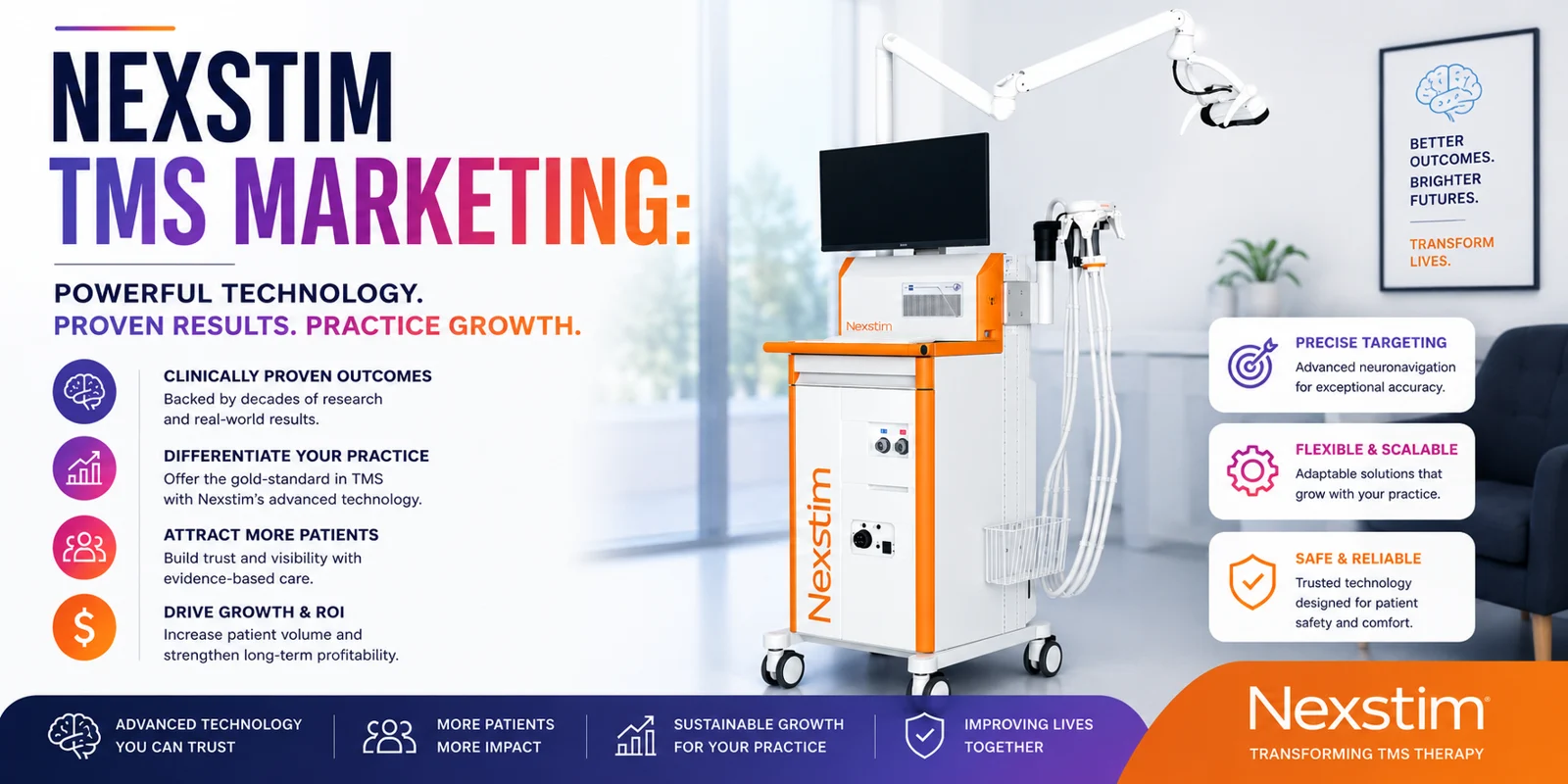
If you are looking for Nexstim TMS Marketing, we can help. Nexstim didn’t start in depression treatment. The company began in neurosurgery—developing navigated brain stimulation technology to map critical brain functions before tumor resections and other procedures where millimeter precision determines whether a patient walks and talks normally afterward.
That surgical-grade precision now treats depression. Nexstim’s NBT (Navigated Brain Therapy) system uses SmartFocus technology to visualize the exact electric field induced in each patient’s brain during stimulation. It’s not estimating where treatment goes—it’s showing exactly where treatment goes, based on that patient’s individual anatomy.
This is the most sophisticated targeting available in clinical TMS. For certain patients—those who’ve failed other treatments, those who travel for the best care, those who research extensively before making healthcare decisions—that precision matters.
This guide covers how to position Nexstim’s unique capabilities to attract patients for whom precision is the deciding factor. For foundational TMS marketing principles, see our complete guide. Learn more by reading our TMS Therapy Marketing Guide.
Nexstim’s Marketable Differentiators
Nexstim occupies a unique position in TMS: the most technologically sophisticated option, with precision capabilities that no competitor matches.
SmartFocus E-Field Navigation
Other TMS devices navigate using coil position—they track where the coil is relative to the head. Nexstim’s SmartFocus technology goes further: it calculates and displays the actual electric field induced in the brain tissue during stimulation.
This matters because coil position isn’t the same as treatment effect. Brain anatomy varies between individuals. Skull thickness varies. Brain folding patterns vary. The same coil position on two different patients produces different electric field distributions in their brains.
SmartFocus uses the patient’s own MRI data to model exactly where stimulation goes—not approximately, but precisely. The system visualizes the electric field location and magnitude in real-time during treatment. This is the only TMS technology that shows clinicians exactly what’s happening in each patient’s brain.
For marketing, this translates to the ultimate precision message: “Treatment targeted specifically to your brain, not a statistical average.” Patients who’ve failed other TMS have reason to wonder if their treatment was actually reaching the right target. Nexstim provides an answer.
Neurosurgical Heritage
Nexstim’s technology comes from neurosurgery, where it’s used for pre-surgical brain mapping—identifying motor and speech areas before operations that risk damaging these critical regions. The company has FDA clearance for navigated brain stimulation in pre-surgical mapping, separate from its depression treatment clearance.
This heritage matters for positioning. The same technology trusted to map the brain before surgery—where errors have immediate, visible consequences—now treats depression. “Surgical precision” isn’t marketing hyperbole; it’s literally the technology’s origin.
For patients researching TMS, the neurosurgical connection provides credibility that purely psychiatric devices lack. This isn’t technology developed for mental health and hoping it’s precise enough—it’s technology developed for the highest-stakes brain procedures and applied to mental health.
Personalized DLPFC Targeting
Standard TMS protocols target the dorsolateral prefrontal cortex (DLPFC) using standardized methods—measuring from motor cortex location, using scalp measurements, or applying population-average coordinates. These methods work for most patients, but they’re approximations.
Nexstim’s system identifies the DLPFC target based on each patient’s individual brain anatomy. Using the patient’s MRI, the system shows exactly where the treatment target is in that specific brain—not where it statistically should be based on population averages.
For patients who’ve failed other TMS treatments, personalized targeting offers hope: maybe the previous treatment missed their specific target. It’s impossible to know for certain, but the possibility provides a legitimate rationale for trying Nexstim after other TMS hasn’t worked.
MRI-Based Treatment Planning
Nexstim treatment typically includes an MRI as part of treatment planning. This additional step adds cost and time, but it enables the precision targeting that differentiates the system.
In marketing, the MRI requirement can be positioned as a premium feature rather than an inconvenience: “Your treatment planned from your own brain scan.” Patients who value precision understand that accuracy requires data—and MRI provides the data that enables Nexstim’s targeting capabilities.
Premium Positioning Strategy
Nexstim isn’t trying to be the most accessible or most affordable TMS option. It’s the most precise. Marketing should embrace this premium position rather than competing on factors where other devices may win.
The “Best Available” Positioning
Some patients want the best option regardless of other factors. They research extensively, they’re willing to travel, they care about precision more than convenience. For these patients, positioning Nexstim as “the most sophisticated TMS available” resonates.
This positioning attracts patients who self-select for quality. They’re often excellent patients—compliant, engaged, appreciative of expertise. They also tend to refer other quality-focused patients.
The “Second Chance” Positioning
For patients who’ve tried TMS elsewhere without success, Nexstim offers a different approach—not just a different device, but fundamentally different targeting methodology. “Failed TMS? Precision targeting might reach what was missed” opens the door to patients who’ve given up on TMS.
Geographic Destination Positioning
Nexstim’s limited U.S. installation base means patients may need to travel for treatment. Rather than viewing this as a limitation, position it as destination care: patients travel for the best treatment options, and precision TMS is worth traveling for.
Target Audiences for Nexstim TMS Marketing
TMS Non-Responders
Patients who’ve tried TMS with other devices and didn’t respond adequately represent a natural Nexstim audience. They already believe in TMS conceptually—they just didn’t get results. Nexstim’s precision targeting offers a reason to try again.
Marketing to this audience should acknowledge their disappointment while offering hope: “When standard TMS didn’t work, precision-guided treatment might make the difference.”
Research-Intensive Patients
Patients who research extensively, compare options carefully, and make evidence-based decisions often gravitate toward the most sophisticated option. They appreciate technical explanations, want to understand the science, and value precision.
Content for this audience should be technically substantive. Explain E-field modeling, discuss why individual anatomy matters, provide the scientific rationale for personalized targeting.
Patients Willing to Travel
Some patients will travel for what they perceive as superior care. Geographic marketing—”Precision TMS worth traveling for”—captures this audience.
Academic Medical Center Referrals
Physicians at academic centers often appreciate sophisticated technology and evidence-based approaches. Nexstim’s navigation capabilities and neurosurgical origins resonate with this audience.
Content Strategy for Nexstim Practices
Technical Content
Nexstim’s audience responds to technical substance:
- “How E-Field Navigation Improves TMS Precision” — explains the technology’s core advantage
- “Why Your Brain Anatomy Matters for TMS Targeting” — connects personalization to outcomes
- “From Neurosurgery to Depression: The Nexstim Story” — leverages surgical heritage
- “When Standard TMS Doesn’t Work: Precision Targeting Options” — targets non-responders
Comparison Content
Patients researching Nexstim are comparing options. Honest comparison content—acknowledging that Nexstim is more complex and requires MRI, while offering superior precision—helps patients self-select appropriately.
“Nexstim vs. Standard TMS: Is Precision Worth It?” addresses the question directly, helping patients understand if Nexstim matches their priorities.
SEO Strategy for Nexstim Practices
Target Keywords
Brand keywords: “Nexstim TMS near me,” “Nexstim NBT [city],” “SmartFocus TMS”
Precision keywords: “precision TMS,” “navigated TMS therapy,” “personalized TMS treatment,” “MRI-guided TMS”
Second-chance keywords: “TMS didn’t work,” “failed TMS treatment,” “TMS non-responder options”
Geographic SEO
If you’re one of few Nexstim providers in a region, regional SEO can attract patients willing to travel. “Nexstim TMS [region/state]” captures searches from patients looking specifically for this technology.
Physician Referral Marketing
Nexstim’s technical sophistication appeals to physicians who appreciate advanced technology and precision medicine approaches.
Academic Psychiatrists and Neurologists
Present Nexstim’s E-field navigation, the neurosurgical heritage, and the peer-reviewed literature supporting precision targeting. Physicians want substance, not just marketing claims.
Referring After Other TMS Failure
Position your practice as the second-line option for physicians whose patients didn’t respond to standard TMS. “When your patient failed TMS elsewhere, precision targeting offers another approach.”
Marketing the Precision Premium
Nexstim isn’t for everyone—and that’s the point. It’s for patients who value precision above convenience, who research their options thoroughly, who are willing to invest in the most sophisticated approach available.
Effective Nexstim marketing doesn’t try to compete with higher-volume devices on accessibility or simplicity. It competes on precision, on personalization, on the surgical-grade accuracy that no other clinical TMS device can match.
For the right patients—those who’ve failed other treatments, those who research extensively, those who travel for superior care—Nexstim’s precision is exactly what they’re looking for. Your marketing just needs to help them find you.