
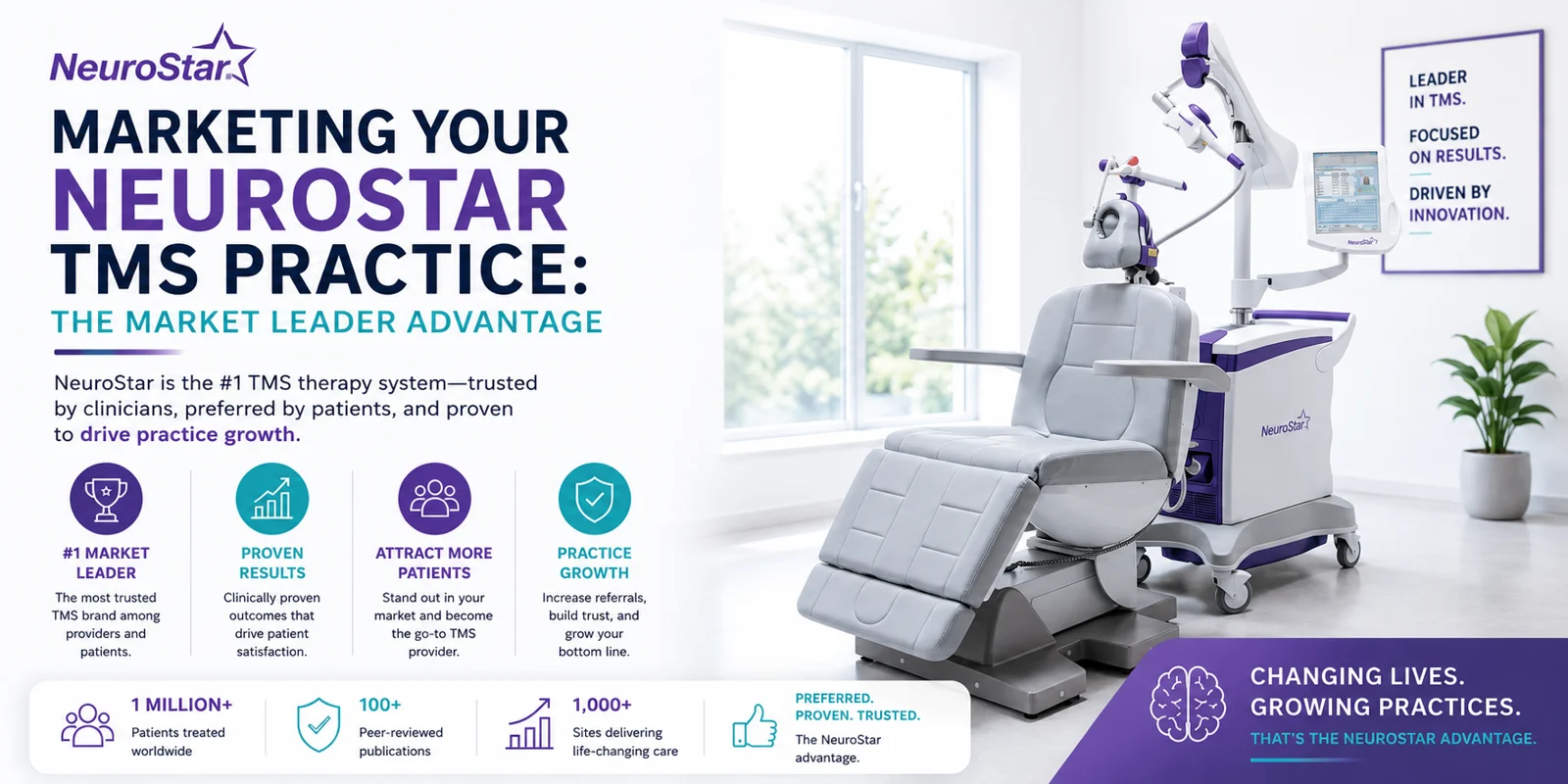
Marketing Your NeuroStar TMS Practice with Neurovo is easy. NeuroStar didn’t just enter the TMS market—it created the TMS market. When Neuronetics received the first FDA clearance for TMS depression treatment in 2008, there was no established patient awareness, no insurance coverage infrastructure, no referral pathways. The company built all of it.
That pioneer status matters for your marketing. With over 6 million treatments delivered through the TrakStar outcomes registry, NeuroStar has accumulated more real-world clinical data than any competitor. More practices use NeuroStar than any other TMS system. More patients recognize the name.
But market leadership doesn’t market itself. The advantages NeuroStar provides—credibility, data, brand recognition, and now exclusive access to adolescent patients—only create value when practices actively leverage them in their patient acquisition strategy.
This guide covers how to translate NeuroStar’s strengths into marketing that fills your treatment chairs. For broader TMS marketing principles that apply regardless of device, see our complete guide. TMS Therapy Marketing Complete Guide.
NeuroStar’s Marketable Differentiators
Every TMS device has FDA clearance for depression. That’s table stakes. What sets NeuroStar apart—and what should set your marketing apart—are the specific advantages that matter to patients making treatment decisions.
First FDA-Cleared TMS: The Pioneer Positioning
“First” carries weight. First to market means longest track record. It means the company that invested in proving TMS works when others hadn’t. It means the system that physicians and insurers have the most experience with.
In patient-facing marketing, this translates to messaging around trust and track record. “The original FDA-cleared TMS” or “Trusted since 2008” positions your practice on the established, proven end of the spectrum—important for patients making a significant treatment decision after years of failed alternatives.
In physician referral communications, pioneer status signals that you’ve chosen the standard-of-care device rather than a newer, less-proven alternative. Referring physicians want to send patients somewhere reliable. First-mover credentials support that narrative.
The Only Adolescent-Cleared TMS: Your Biggest Opportunity
Here’s where NeuroStar marketing gets interesting. NeuroStar is the only TMS system FDA-cleared as an adjunct treatment for adolescent patients ages 15-21 with major depressive disorder. No other device has this clearance.
The market opportunity is substantial. Approximately 4.3 million U.S. adolescents are affected by major depressive disorder annually. The existing treatment options for this population are limited—only two oral antidepressants are FDA-approved for adolescents, both carrying black-box warnings about increased suicidal thoughts. Response rates hover around 35%.
Parents of depressed teenagers are desperate for alternatives. They’re worried about medication side effects. They’ve watched their kid struggle through multiple failed prescriptions. They’re Googling at midnight looking for anything that might help. And right now, only NeuroStar practices can offer them TMS.
This exclusivity won’t last forever—other manufacturers will pursue adolescent clearances. But for now, it’s a window of opportunity for NeuroStar practices to establish themselves as the go-to option for teen depression treatment in their markets.
TrakStar: The Largest Outcomes Registry
NeuroStar’s TrakStar platform has captured data from over 6 million treatments—more real-world evidence than any TMS outcomes database in existence. The adolescent clearance itself was supported by TrakStar data from 1,169 adolescent patients, showing 78% achieved clinically meaningful improvement.
In your marketing, reference this data to support credibility claims. “Backed by 6 million+ treatments” or “Proven outcomes from the largest TMS registry” gives nervous patients something concrete to anchor their decision on.
Multiple Indications, No Hardware Changes
NeuroStar now holds four FDA-cleared indications: major depressive disorder in adults, anxious depression (MDD with comorbid anxiety), OCD as an adjunct treatment, and adolescent MDD. All four work with the same system—no additional coils or hardware purchases required.
This means you can market to multiple patient populations without complexity. One system, multiple conditions, consistent patient experience.
Contact Sensing Technology
NeuroStar’s patented Contact Sensing provides real-time feedback on coil positioning during treatment—alerting technicians if contact is compromised. This technical feature translates to patient-relevant messaging around precision and consistency: confident that each treatment is delivered accurately to the right location every session.
Target Audiences for NeuroStar TMS Marketing
Effective marketing speaks to specific people with specific concerns. NeuroStar’s clearances create access to distinct patient populations, each requiring tailored messaging.
Treatment-Resistant Depression Adults
This is the core TMS market—adults who’ve tried antidepressants without adequate relief. They’re tired of medication side effects, frustrated by trial-and-error prescribing, and skeptical that anything will actually help.
Marketing to this audience emphasizes the non-drug nature of TMS, the ability to treat depression at its source in the brain, and the hope that comes from a fundamentally different approach. Avoid promising what you can’t deliver, but acknowledge their journey and position TMS as a legitimate next step.
Parents of Depressed Adolescents
This audience isn’t the patient—they’re the decision influencer. Parents control healthcare choices for minors, and they carry enormous emotional weight when their child is suffering.
Marketing to parents addresses their specific fears: medication side effects in developing brains, black-box warnings about suicidal thoughts, watching their teenager struggle through academic and social consequences of untreated depression. The message isn’t “TMS is better than medication”—it’s “there’s another option to discuss with your child’s doctor.”
Channel selection matters here. Parents of depressed teens are active on Facebook. They’re in support groups. They’re searching for alternatives late at night when worry keeps them awake. Meeting them in these contexts—with helpful information rather than hard sells—builds the trust that converts to consultations.
Anxious Depression Patients
Over half of MDD patients also experience significant anxiety symptoms. NeuroStar’s anxious depression clearance means you can specifically address this comorbid population—and they’re searching for solutions.
“Depression and anxiety” as a keyword combination opens targeting opportunities that pure depression messaging misses. These patients often feel caught between treatments—antidepressants that don’t help anxiety, anti-anxiety medications that don’t address depression. Positioning TMS as addressing both creates differentiation.
OCD Patients (Adjunct Treatment)
NeuroStar’s OCD clearance is for adjunct treatment—meaning it supplements existing therapy rather than replacing it. This is a smaller market than depression, but OCD patients are often highly motivated and well-researched about their condition.
Marketing to OCD patients requires nuance. They’ve likely already tried medication and ERP (exposure and response prevention) therapy. They understand their condition deeply. Surface-level content doesn’t resonate. Detailed, accurate information about how TMS fits into comprehensive OCD treatment—as one component, not a magic solution—builds credibility with this sophisticated audience.
NeuroStar-Specific Content Strategies
Leveraging Manufacturer Resources
Neuronetics provides substantial marketing support that many practices underutilize. The NeuroStar website includes a practice locator driving patient inquiries to listed providers. Co-branded patient education materials are available. Practice success managers can discuss cooperative marketing opportunities.
At minimum, ensure your practice is properly listed in Neuronetics’ provider directory with accurate information and all applicable indications. Patients searching the NeuroStar website for local providers represent high-intent leads—they’ve already decided on the technology and are looking for where to get it.
Blog Content That Captures Search Traffic
Device-specific content captures patients already researching NeuroStar. Consider topics like:
- “What to Expect During NeuroStar Treatment” — walks through the actual patient experience
- “NeuroStar vs. Other TMS Devices: Understanding Your Options” — honest comparison that still favors your device
- “TMS for Teen Depression: What Parents Need to Know” — targets the adolescent market opportunity
- “Does Insurance Cover NeuroStar TMS?” — addresses the question patients ask most frequently
- “NeuroStar Treatment Timeline: How Long Until You Feel Better?” — manages expectations while providing value
Video Content Opportunities
Video reduces anxiety about unknown medical procedures. A simple walkthrough of a NeuroStar session—showing the treatment chair, the coil positioning, the actual treatment sounds and sensations—demystifies the experience for prospective patients.
Patient testimonials, with proper HIPAA-compliant consent, provide social proof that written reviews can’t match. For adolescent marketing specifically, video content featuring parents discussing their decision-making process connects with other parents in similar situations.
SEO Strategy for NeuroStar Practices
Local Search Optimization
“NeuroStar near me” and “NeuroStar TMS [city name]” represent patients with high purchase intent. They’ve researched TMS, selected NeuroStar, and are looking for a local provider. Ranking for these searches delivers qualified leads.
Your Google Business Profile should mention NeuroStar explicitly in the business description. Regular posts about TMS topics keep the profile active. Photos of your treatment space—including the NeuroStar system—add visual credibility.
Target Keywords
Beyond obvious terms like “NeuroStar TMS” and “NeuroStar therapy,” consider the questions patients actually type:
- “NeuroStar reviews” / “NeuroStar success rate”
- “NeuroStar side effects” / “Does NeuroStar hurt”
- “NeuroStar cost” / “NeuroStar insurance coverage”
- “TMS for teenagers” / “TMS for adolescent depression”
- “NeuroStar vs BrainsWay” / “NeuroStar vs MagVenture”
Paid Advertising for NeuroStar Practices
Google Ads Approach
Google Ads for TMS practices work best when targeting high-intent searches. Campaigns built around “NeuroStar + location” and “TMS therapy + location” keywords capture patients ready to choose a provider.
Ad copy must stay within FDA guidelines. Focus on factual claims: “FDA-cleared,” “non-drug treatment,” “covered by most insurance.” Avoid outcome promises or language implying guaranteed results.
Meta (Facebook/Instagram) Advertising
Meta’s targeting capabilities make it valuable for reaching specific demographics—particularly parents of adolescents for NeuroStar’s unique clearance. Interest targeting around depression, mental health, and parenting topics can identify relevant audiences.
Educational content performs better than direct response ads on social platforms. A video explaining “FDA-cleared option for teen depression” that links to an informational landing page generates engagement and builds awareness.
Physician Referral Marketing
Psychiatrist Outreach
Psychiatrists managing treatment-resistant patients are your primary referral target. They have patients who’ve failed multiple medications and need another option. Your job is making the referral easy and keeping them informed about outcomes.
Referral materials should emphasize NeuroStar’s evidence base, insurance acceptance, and your communication protocols. Psychiatrists want to know: Will you keep me updated on my patient’s progress? Will I get them back after treatment for ongoing management? Address these concerns directly.
Pediatricians and Adolescent Medicine
The adolescent clearance opens referral opportunities from providers who may not have considered TMS before. Pediatricians, adolescent medicine specialists, and pediatric psychiatrists all see depressed teenagers—many of whom struggle with or can’t tolerate medication.
Educational outreach to these specialties introduces TMS as an option they may not know exists for their patients. Focus on the safety profile (non-systemic, no medication interactions) and the TrakStar data supporting adolescent efficacy.
Primary Care Physicians
PCPs prescribe the majority of antidepressants in the United States. When those prescriptions don’t work well enough, PCPs need somewhere to send patients.
Keep PCP communications simple. They need to know: TMS is FDA-cleared, insurance covers it, their patients can stay on current medications during treatment, and you’ll handle everything from here.
Making NeuroStar’s Advantages Work for Your Practice
NeuroStar provides marketing advantages that other TMS devices don’t: pioneer status, the largest outcomes database, exclusive adolescent clearance, and the brand recognition that comes from market leadership. But advantages only matter if you use them.
The practices filling their NeuroStar chairs aren’t doing anything magical. They’re consistently present where patients research TMS. They create content that answers real questions. They make it easy to take the next step. They leverage device-specific differentiators instead of generic TMS messaging.
The adolescent opportunity, in particular, won’t remain exclusive forever. Other manufacturers will pursue similar clearances. Practices that establish themselves now as the go-to option for teen depression treatment in their markets build relationships and reputation that persist even when competition arrives.
For foundational TMS marketing strategies that apply across all devices, see our comprehensive TMS therapy marketing guide. TMS Therapy Marketing Complete Guide.
For tracking whether your marketing investment is paying off, our guide to measuring TMS marketing success covers the metrics that matter. How to Measure TMS Marketing Success.
Published by Neurovo — Specialized Marketing for Mental Health Practices Sources: Neuronetics investor relations, FDA 510(k) clearance documents, TrakStar outcomes data